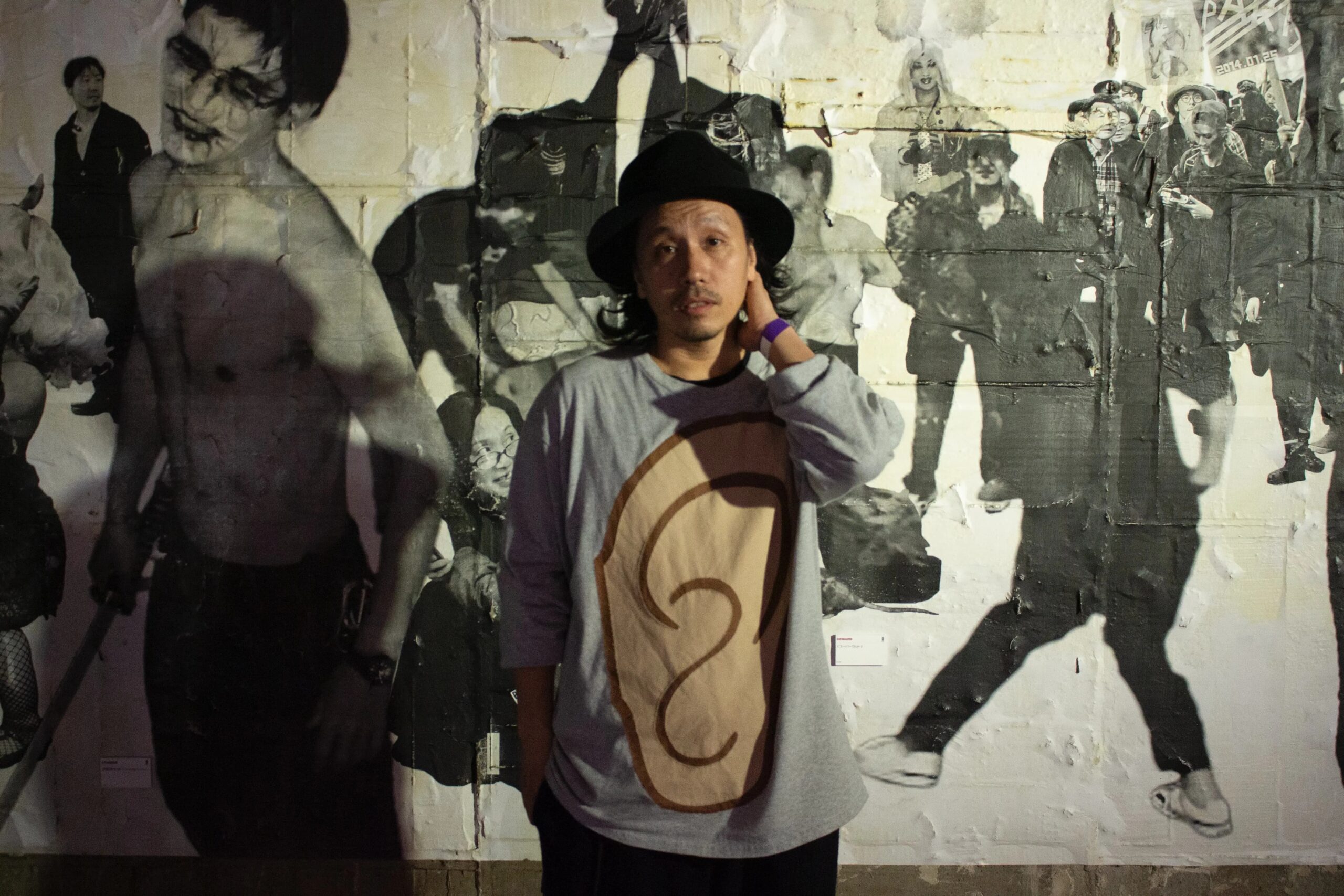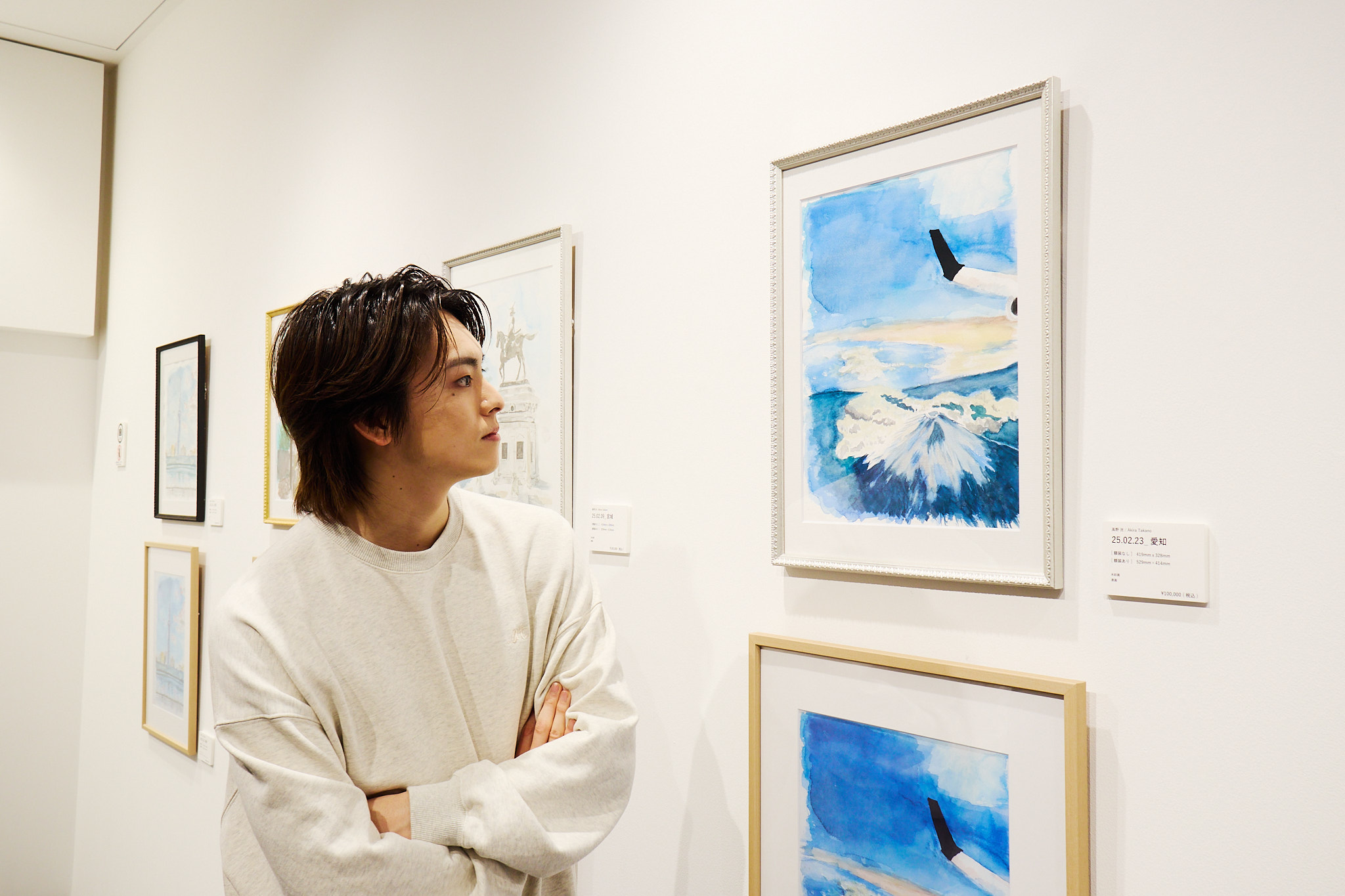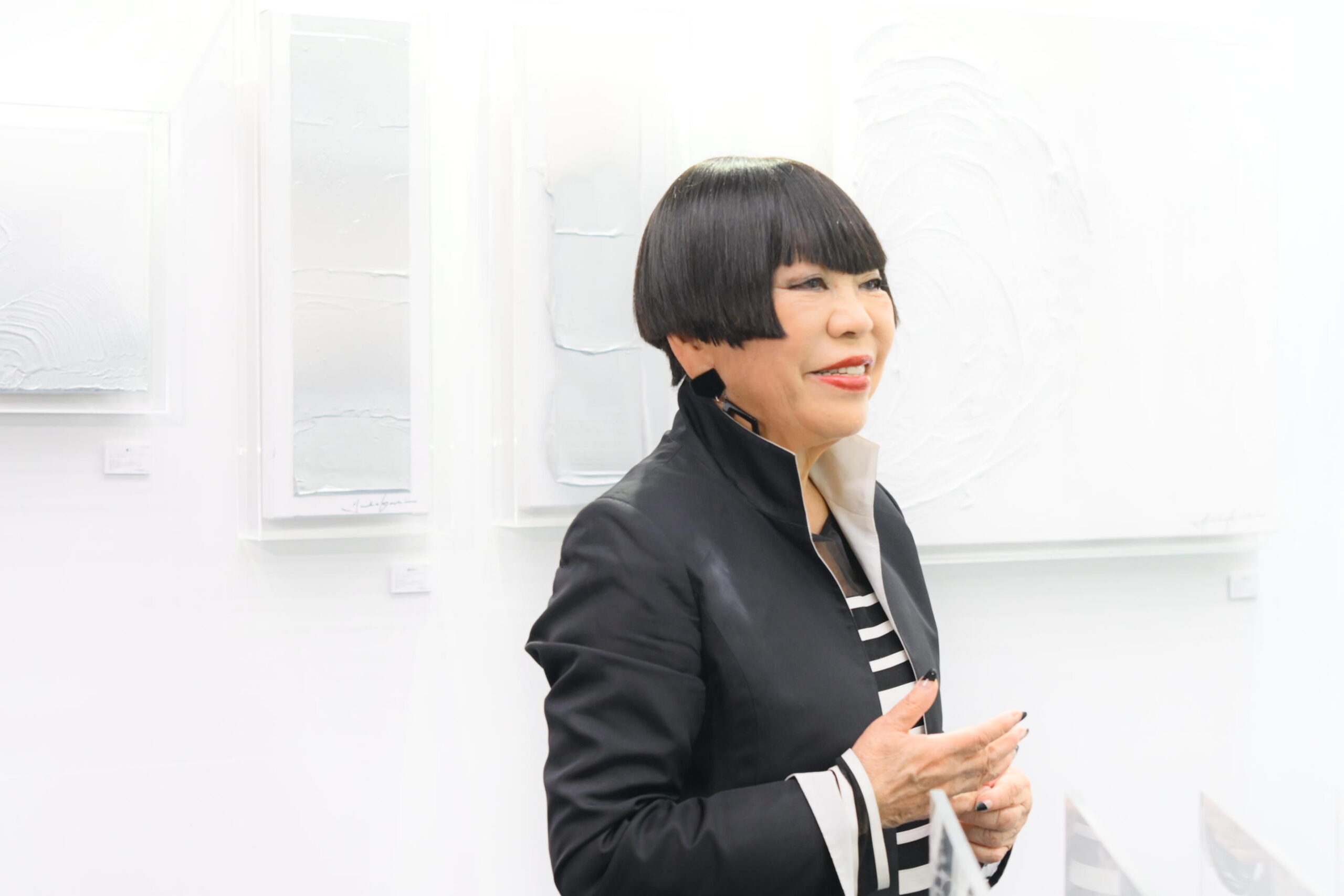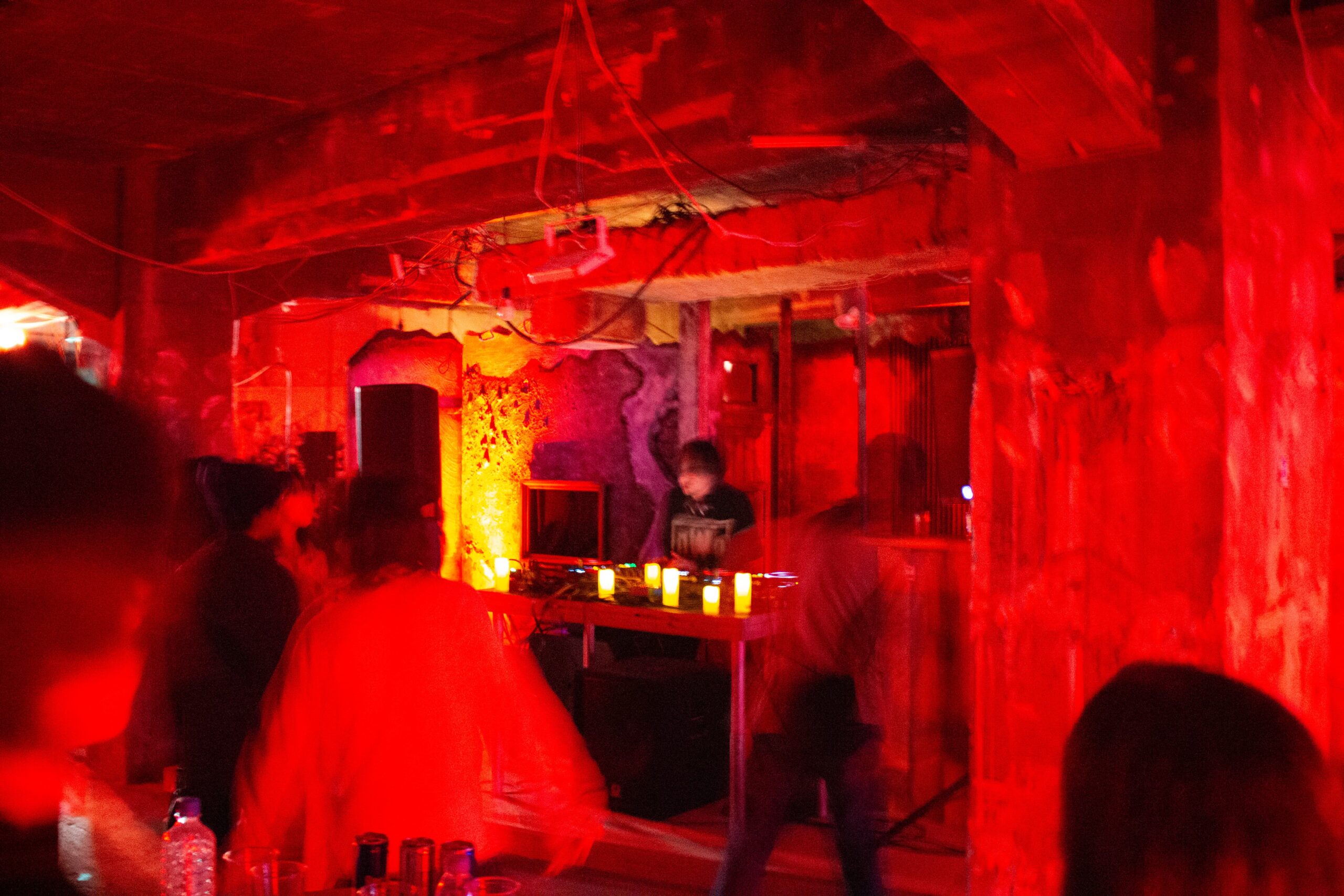
Held over three days starting November 1, 2025, “BENTEN 2 Art Night Kabukicho” was an all-night art event curated by Chim↑Pom from Smappa!Group. Set in Kabukicho, known as the “No. 1 Entertainment District in the East,” the event featured simultaneous occurrences—”something” happening all at once—across various venues scattered throughout the city.
So, what exactly took place in Kabukicho?
The Dynamism of “Kabukicho” Continuing from Kihei Suzuki
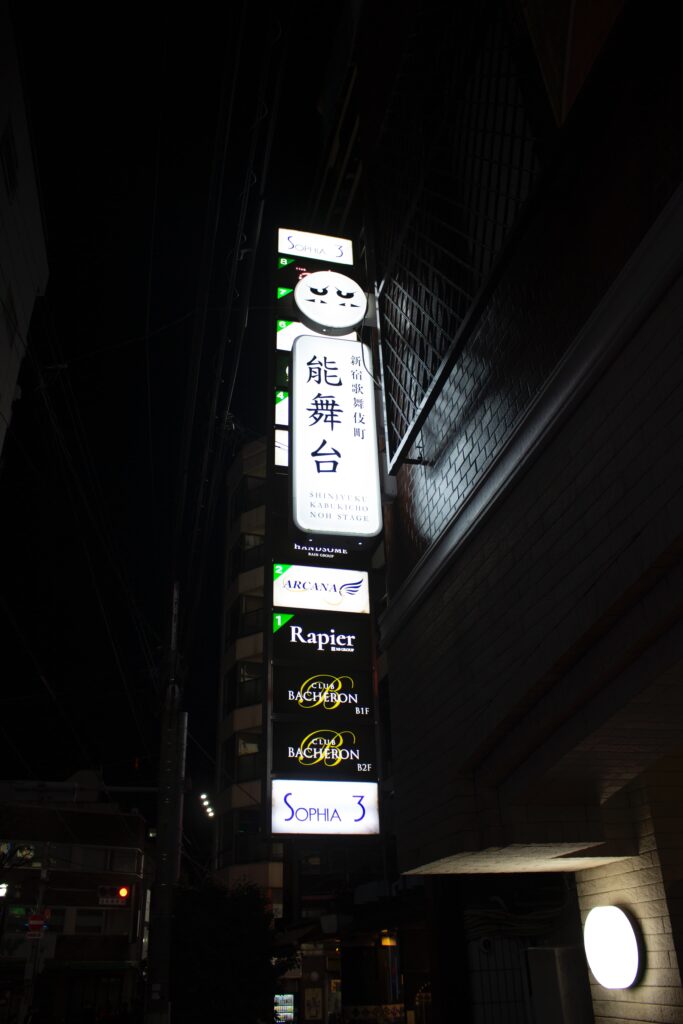
Leaving the Ojo Building (one of the venues), I headed toward the “Shinjuku Kabukicho Noh Stage.” In a recent interview, Ryuta Ushiro of Chim↑Pom from Smappa!Group remarked:
“I believe this place will become the identity for future cultural activities in Kabukicho.”
“Having a Noh stage in an entertainment district might look peculiar at first glance, but contextually, it is legitimate and natural.”
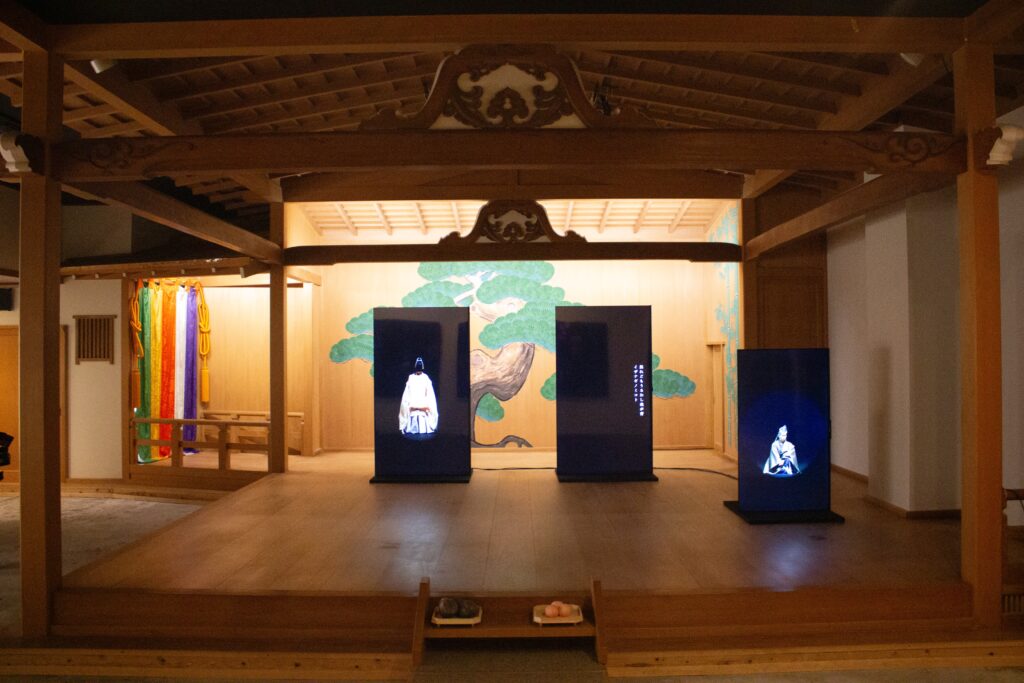
The Shinjuku Kabukicho Noh Stage is located in a corner of a building surrounded by love hotels. After entering a recessed doorway and climbing to the second floor, a door finally appears. It certainly isn’t “normal.”
However, the history of this location dates back to 1941. At that time, the area was known as “Yodobashi-ku Tsunohazu 1-chome Kitamachi.” During the war, most of the town was burned down. As part of the reconstruction efforts to revitalize the town, Kihei Suzuki, the neighborhood association chairman at the time, envisioned a “Cultural City” centered around a theater performing Kabuki. aiming to attract a Kabuki-za theater, the name was changed to the current “Kabukicho” in 1947.
Ironically, the plan to attract the Kabuki-za never materialized, and only the name “Kabukicho” remained…
Or so it seemed.
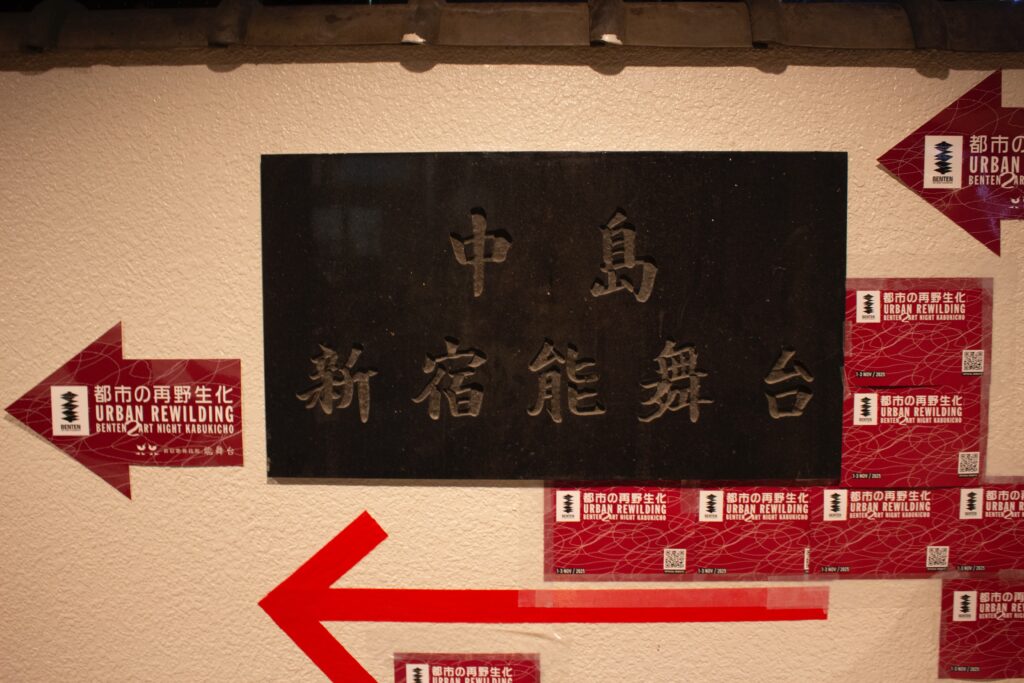
Amidst this history, the “Nakajima Shinjuku Noh Stage” was born in 1941. In 2022, it was renamed the “Shinjuku Kabukicho Noh Stage” after the facility was purchased by Smappa!Group, which primarily operates host clubs. The chairman, Maki Tezuka, serves as a standing director of the Kabukicho Shopping Center Promotion Association and is dedicated to the current cultural development of Kabukicho. (His thoughts are detailed in the previous article: [Interview] Roaming Through the Entertainment Capital: Behind the Scenes of “BENTEN 2 Art Night Kabukicho” — Maki Tezuka Edition.
Adding the name “Kabukicho” to the “Nakajima Shinjuku Noh Stage” may be a manifestation of his resolve to “inherit the will of Kihei Suzuki.”
Outside the Noh stage, I spoke with a woman working in the food and beverage industry who happened to be there.
“I learned about the Ojo Building through the ‘Narakky’ event held previously. I don’t usually come to Kabukicho much, but the performance by Karagumi on the 2nd floor and the Shinjuku Kabukicho Noh Stage were amazing.”
It may take time to fully realize the future city image Kihei Suzuki envisioned. However, this was a moment where I felt a steady dynamism born from the soil of the city and the flow of history, even within this district of love hotels.
Not Spectators, But Participants. What’s inside the Kabukicho Locker…?
Next, I headed to “THE FOUR-EYED,” a select shop serving as one of the venues. Here, artist Bokunou was holding the “Pho Heng Black Market” .
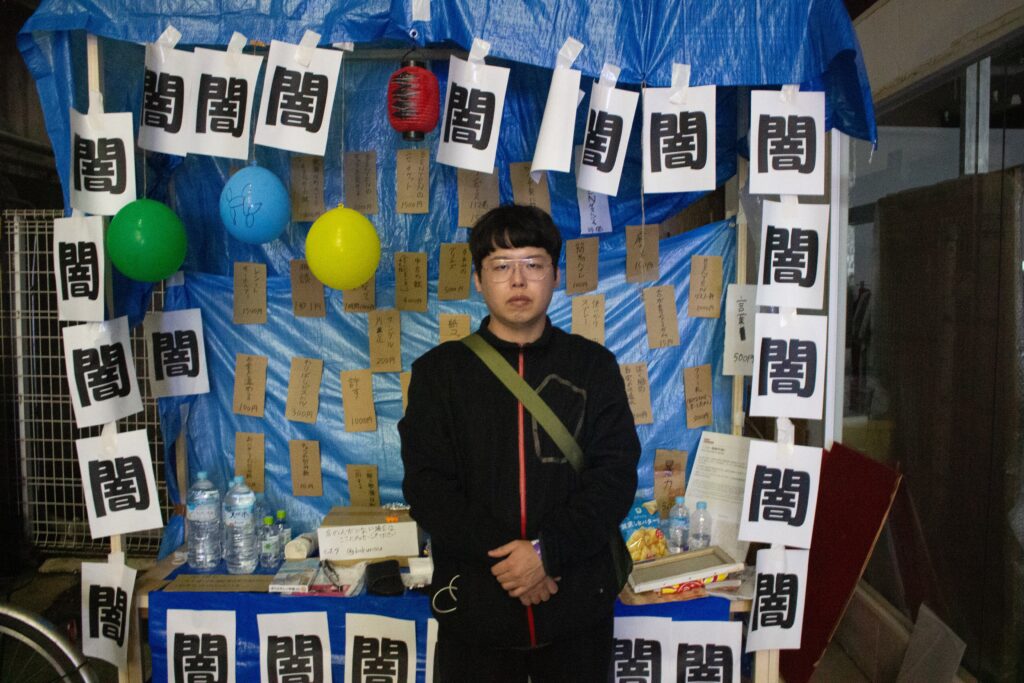
What kind of initiative is the “Pho Heng Black Market”?
Bokunou: Looking at the recent surge in prices on flea market apps and vintage clothing, I feel something close to a “black market.” Originally, I think black markets were born because people couldn’t get the necessities of life. So, I’m thinking in the context of taking things that have turned into a black market—flowing into the digital world like flea market apps—and daring to bring them back to the physical world. I’m focusing on experiences and concepts, and there are even menu items that “money can’t buy.” I think there is meaning in doing this right next to a glamorous select shop.
Do you have a personal highlight item?
Bokunou: I rented one coin locker located somewhere in the streets of Kabukicho and put an exhibit inside it. Kabukicho has quite a lot of lockers, but the exhibit is in just one of them. You get the key, but you also have to hunt for which locker the key belongs to.
That sounds a bit like an illicit deal. Could you give a comment to the participants?
Bokunou: Of course, it’s fine to just come and see the “art” in the normal sense. But, like the experience I just mentioned, or going for a walk together, this event has many forms of “doing something together.” So, there isn’t a single “spectator” here; everyone who came is a participant. Please actively drink, buy, experience, and enjoy walking through the city!
Making “Miso” and Dancing in the Middle of Kabukicho
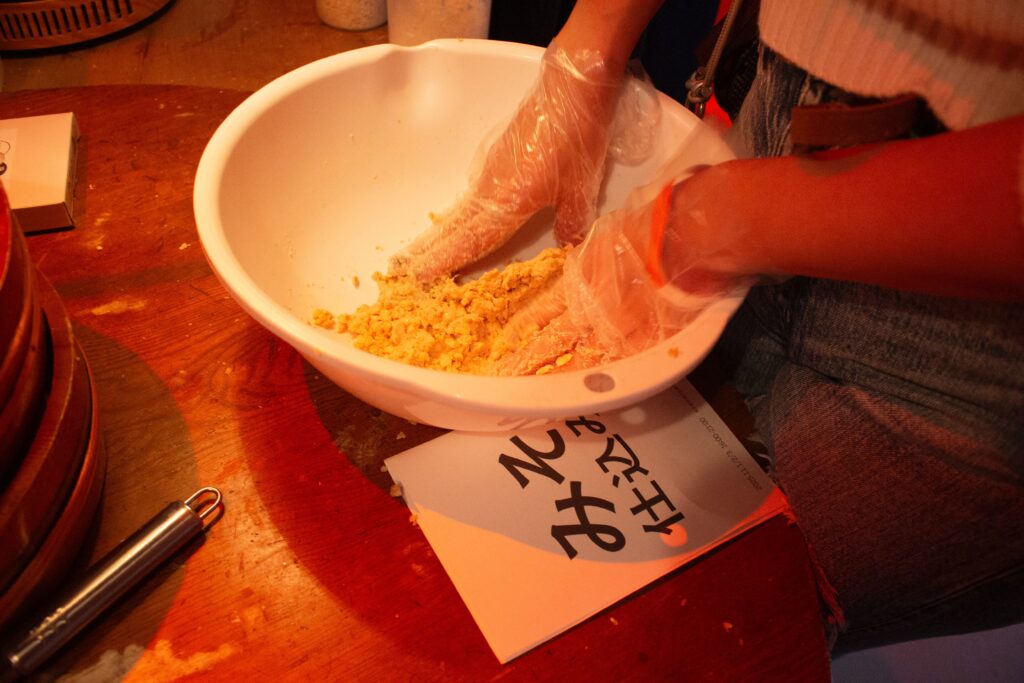
My next destination was “Decameron.” Opened in 2020, this art space exhibits works on the second floor, while the first floor houses a bar designed to spark dialogue after viewing the art. Tonight, artist Yuta Geshi is holding the “Living Party feat. Miso Preparation” here. Apparently, the “miso” prepared tonight will be stored at room temperature with low humidity and will be ready to eat in about a year. What exactly is a miso-making site where a DJ plays music?
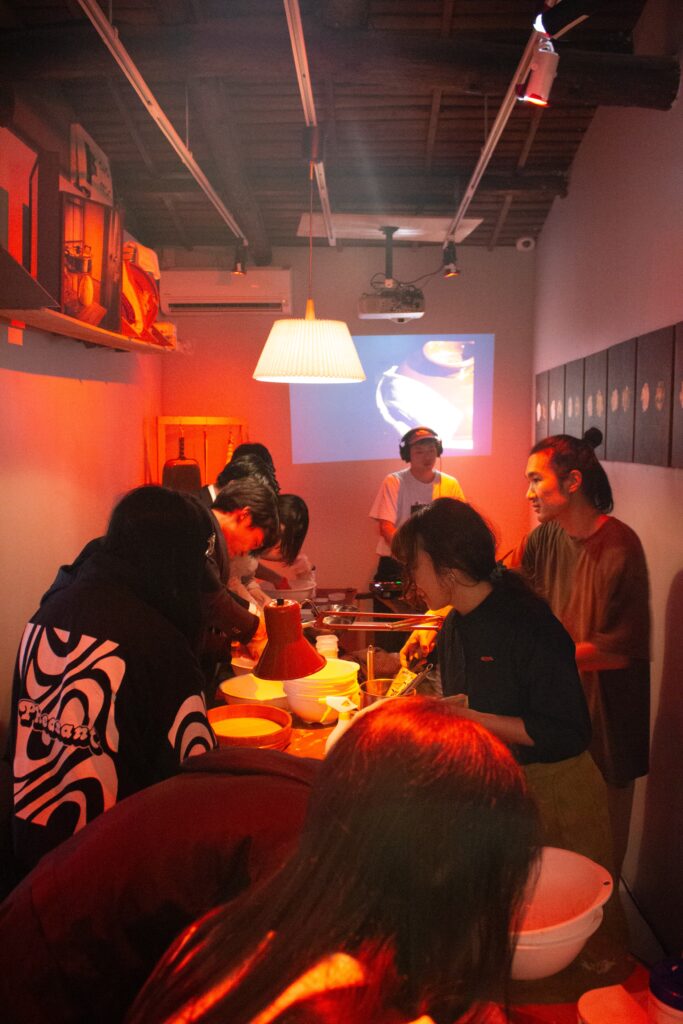
“Making miso while dancing to music” right in the middle of an entertainment district. I think this was quite a unique attempt, but how did it go?
Yuta Geshi: I didn’t expect the gals from the “Gal Bar” at Decameron to enjoy the miso soup this much. I was really happy about that.
Do you have any specific thoughts regarding holding this event?
Yuta Geshi: Domestic labor and acts done for the sake of living are hard to tie to “monetary value,” aren’t they? I thought the gap of doing something like that in “Kabukicho” would be interesting. However, I’ve actually been doing this miso making for three years now, preparing 20 kilos of miso every year. It’s quite hard work, and it started from the thought, “It would be nice to have music at times like this.” Rather than trying to make a statement through this activity, it’s more about my own desires or personal feelings.
Next, I asked for a comment from Ryotaro Sakaguchi, a performer who happened to be there experiencing the “miso making.”
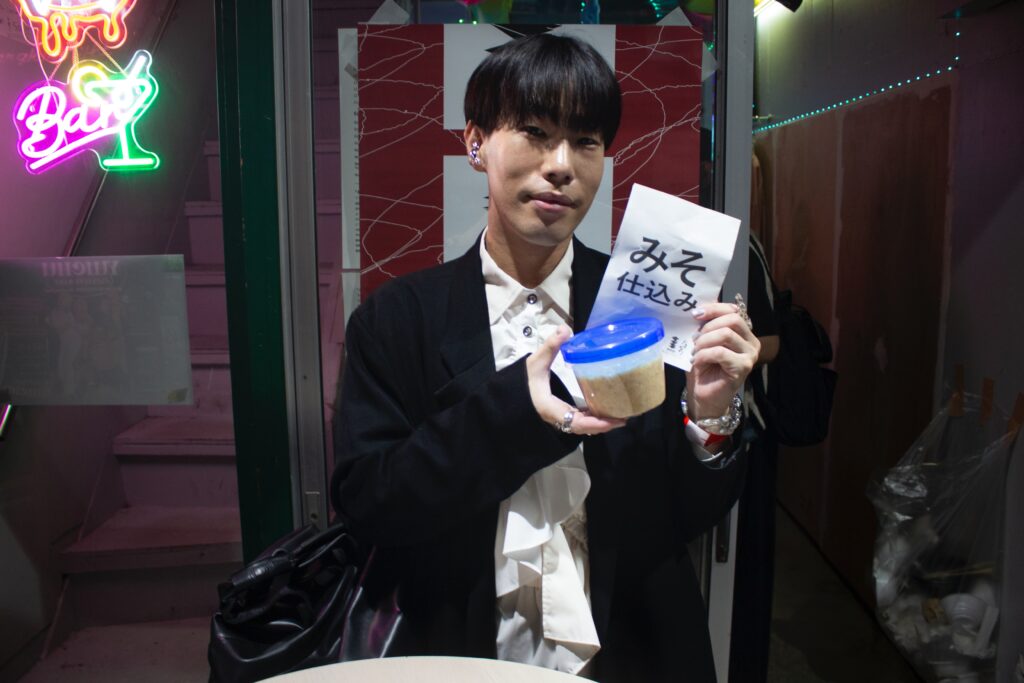
Could you give us a quick thought on experiencing the miso making?
Sakaguchi: I’m Ryotaro Sakaguchi, a performer. The miso I prepared while dancing in Kabukicho will be ready around this time next year. I want to come back to this place then to tell you how it tastes.
Taking a Bird’s-Eye View as a Researcher: The City as Envisioned by Naoki Saito
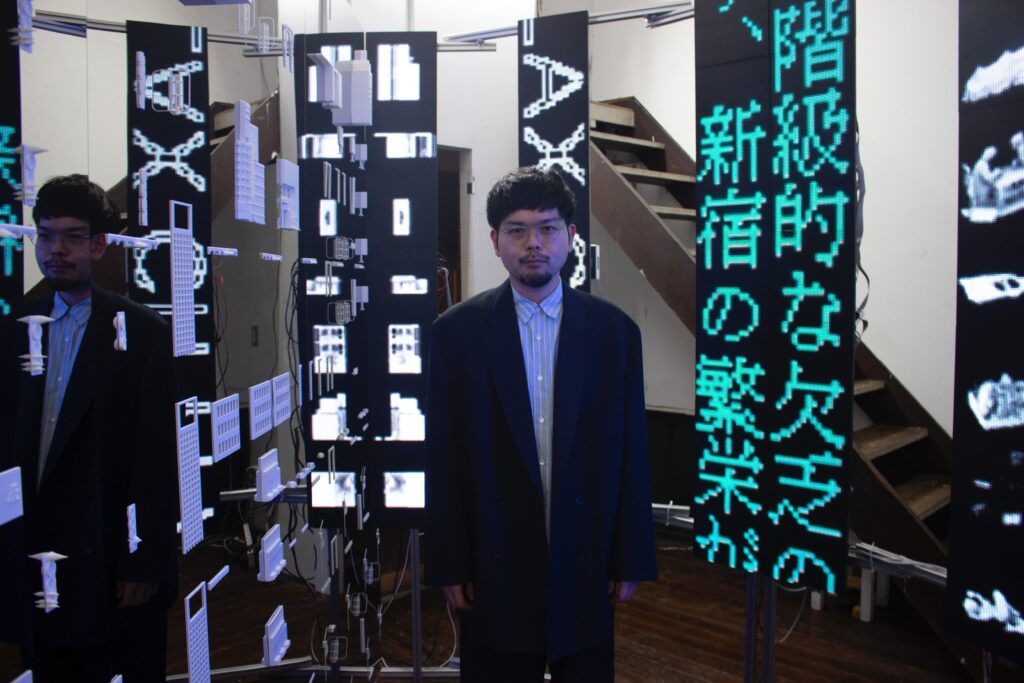
Held at “WHITEHOUSE” is the exhibition Lived Shinjuku “Parallax city” by the architectural collective GROUP. It features over 2,000 photographs of Shinjuku left by critic Koji Taki. From his gaze upon Shinjuku folded within these images, the exhibition looks toward a 2025 Shinjuku without him, and eventually, to the city 100 years from now. I spoke with Naoki Saito, a member of the architectural collective GROUP and a Project Assistant Professor at the University of Tokyo’s Institute for Future Initiatives.
What kind of exhibition is this?
Saito: As GROUP, we are creating videos, installations, and group portraits based on works that were exhibited in “Shinjuku: The Phenomenal City” held at MoMA. The point where these many elements combine might share something with the chaotic nature of the current city of Shinjuku.
In “BENTEN,” various things are happening simultaneously all over Kabukicho. What do you think you can do specifically because you are an urban researcher?
Saito: There are many art works themed around the “city,” and while I resonate with them, I also feel we are approaching a saturation point where anything can pass as art if you just say “city.” As a researcher of urban space, I hope to present an artwork that stands up after researching the city. That isn’t the only theme, but I think I can present a different aspect in that regard.
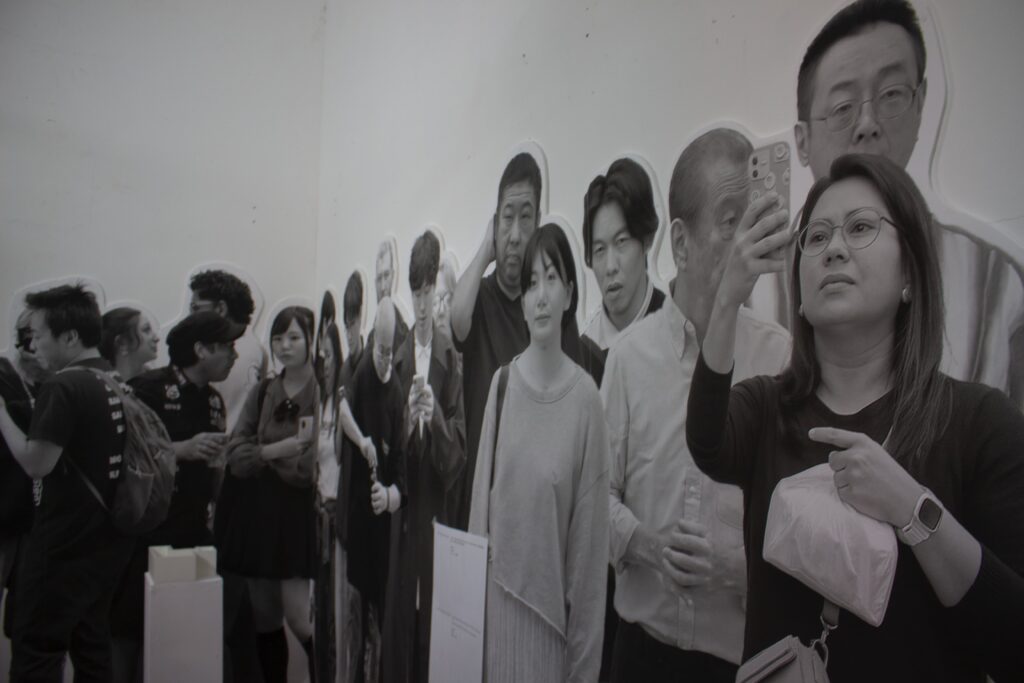
Through events like this, how do you predict Kabukicho will change? Also, is there a wish for how you want it to change?
Saito: Fifty years ago, Koji Taki said, “Shinjuku has no monuments. There is no visible structure; Shinjuku is built by the activities of people.” But now, 50 years later, that “Shinjuku image” Taki spoke of has been packaged and can be seen anywhere in Tokyo. Even so, I think Taki was actually quite sharp.
Regarding what I hope for Shinjuku in the future, I don’t have a specific wish for it to change in a certain way, but I do think Shinjuku will continue to have this… let’s call it “seediness” (waizatsusa), or a kind of scariness. Urban development has an aspect of reducing those parts, but I wonder about eliminating all the gray areas. Rather, I don’t think it’s something that can be changed by manipulation, so as a researcher, I think it’s fine to just watch it from a slightly more bird’s-eye view.
Meeting Up at the Ohjo Building
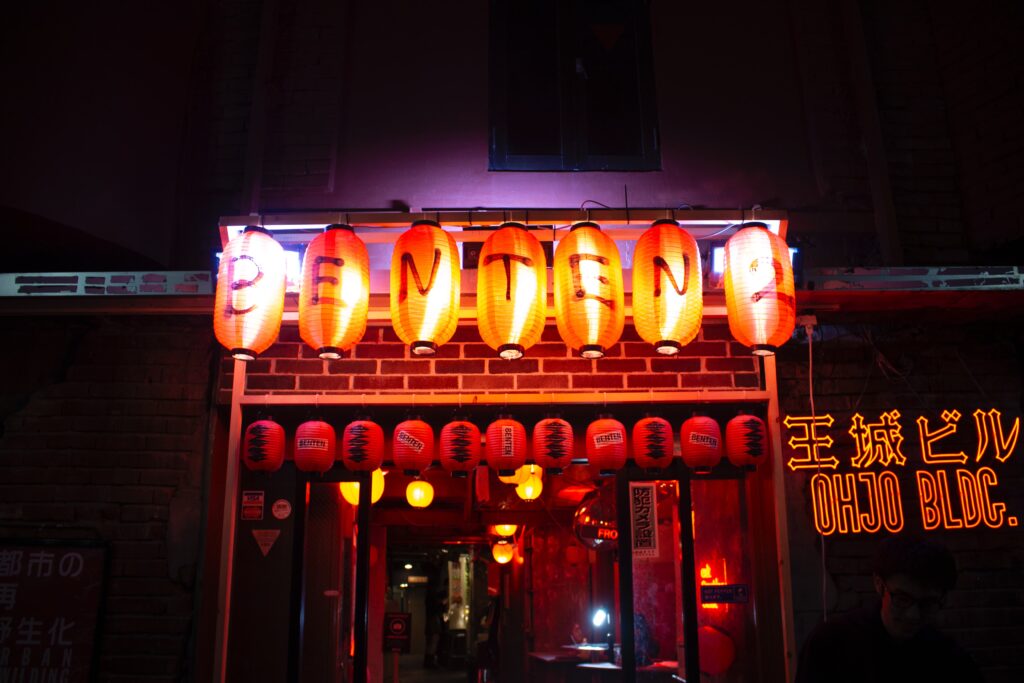
I made my way back to the “Ohjo Building.”
I had asked the people I met at the “Living Party feat. Miso Preparation” at Decameron to call me once their miso was finished and things had settled down. We met up at “Art-yoko” , an area lined with food and merchandise stalls currently being held on the 1st floor of the Ohjo Building.
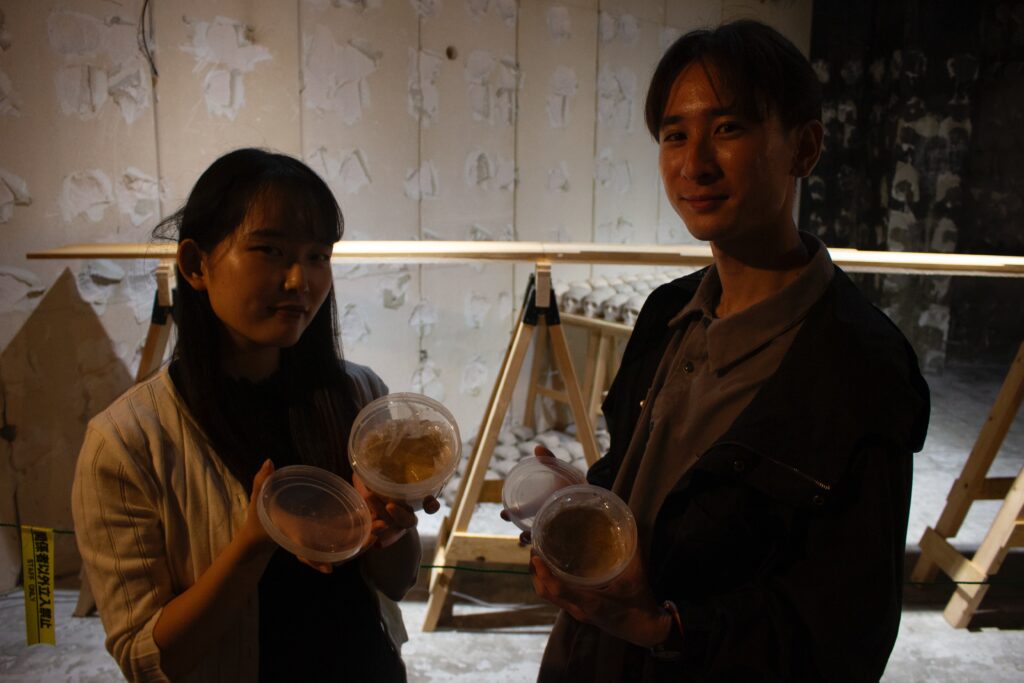
What brought you to this event?
Attendee: I found out about it through an Instagram ad! I also know artist friends active in Shinjuku and Koenji, so it was a topic of conversation even before it started. I’ve been to art events at the Ohjo Building a few times before.
You’ve walked around various parts of Kabukicho through “BENTEN.” Has your impression of Kabukicho changed, or did you make any new discoveries?
Attendee: I had no idea there was a Noh stage. I was quite surprised that such a place existed, tucked away in the gaps between buildings.
How was the miso making?
Attendee: There were flyers at the reception of the Ohjo Building, so we went, and it was really fun. Apparently, you take it home, store it, and after about a year, you remove the mold and can eat it. The moisture from the soybeans seeps out and rises to the top, which can be used as soy sauce. I also learned that the taste changes slightly depending on the bacteria on the maker’s hands. It was fun to learn all that.
I thanked the two of them for taking the time to contact me.
Finally, I headed toward “Tokyo Sabaku”.
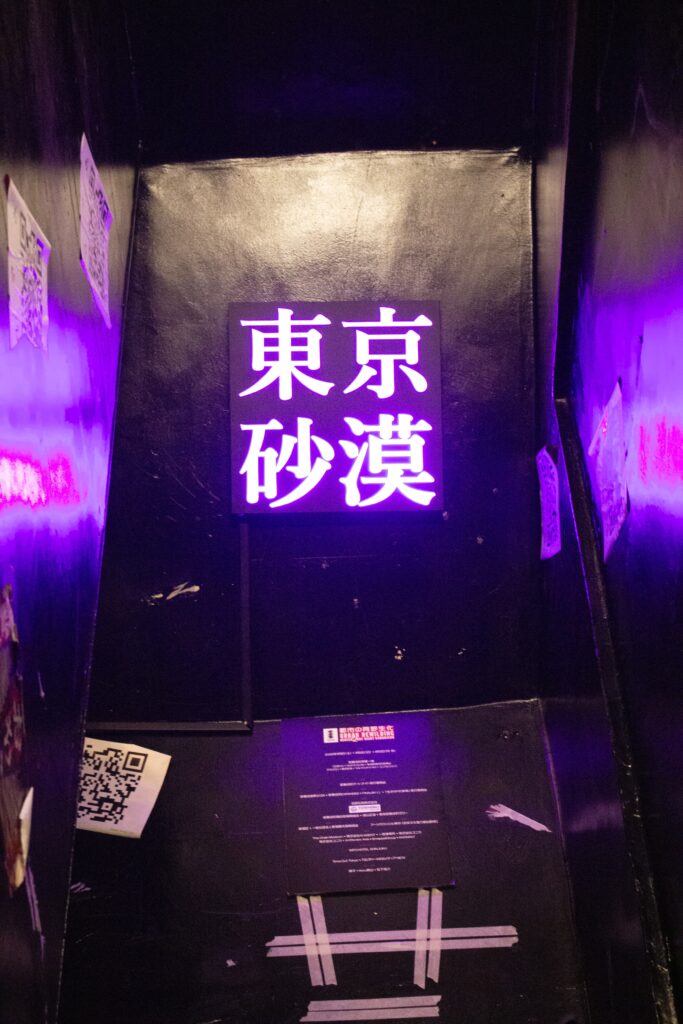
On this day, the “Tokyo Art Community Center”was being revived for the first time in 13 years.
The “Tokyo Art Community Center” was a bar opened by Makoto Aida, serving as a salon where young artists gathered. The venue for tonight, “Tokyo Sabaku,” was created in the footprint of that now-gone place and its spirit. Tonight, Makoto Aida was specially serving as the bartender. Unfortunately, I missed the time Aida was there, but from 11:00 PM to 5:00 AM, his wife and fellow artist, Hiroko Okada, would be standing at the counter.
4:30 AM. The Attic of “Tokyo Sabaku”
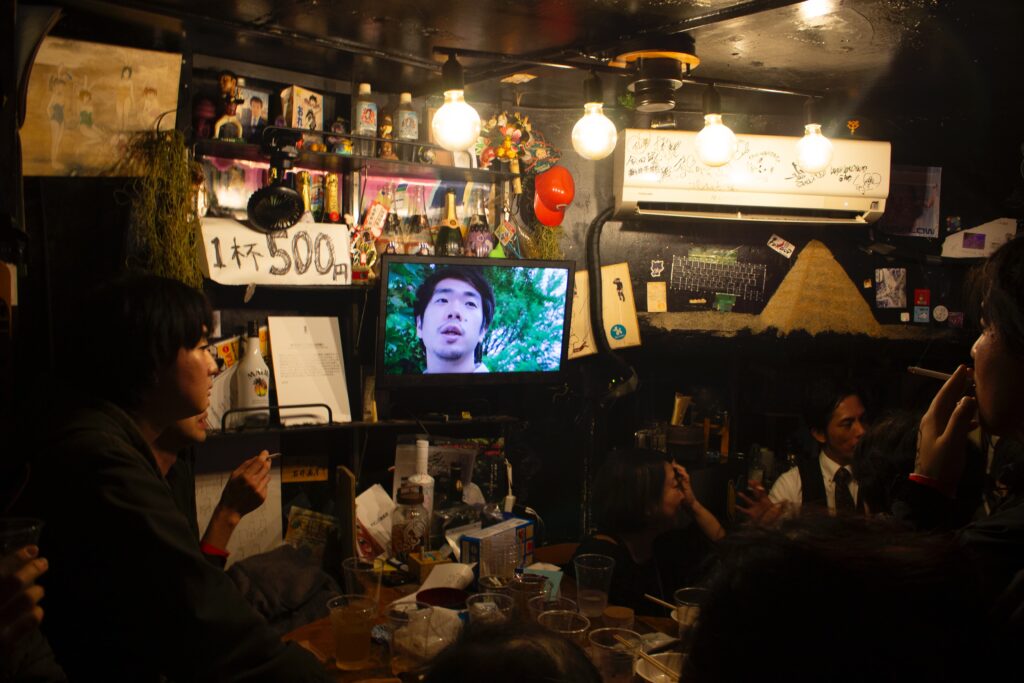
When I arrived at “Tokyo Sabaku,” it was already packed with people. Not only were the chairs taken, but people overflowed into the aisles, happily sharing drinks and conversation. Since it was a bit too crowded and I didn’t want to spoil the mood, I decided to just take some photos. Then, I climbed the stairs to the next floor up, a room like an attic.
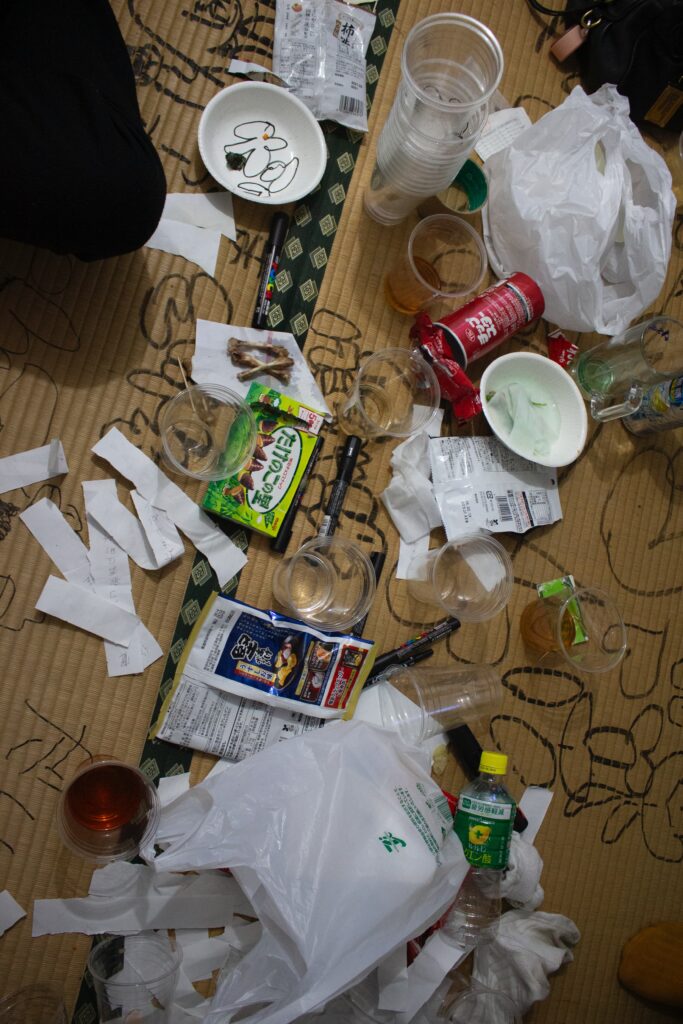
The walls were covered in graffiti—words and drawings written freely with pens—extending even onto the tatami mats. It was a scene of total intoxication, resembling a “home drinking” session but with much higher freedom. I heard later that people were drawing whatever they wanted right next to drawings by Makoto Aida. It’s that kind of place. People of all ages and generations were there. From this space, where everyone was likely quite drunk, I could hear words like “Takashi Murakami” and “My favorite XX literature…”
Knowing it was rude, I pretended to check my camera while eavesdropping. I heard a conversation about philosophy so complex that even listening to that snippet alone was incomprehensible. Unable to resist, I asked the two people in front of me who were engaging in a fierce debate on “Art Theory.” They told me they had just met here moments ago.
Come to think of it, I ran into a certain film director earlier who had come to “BENTEN” looking for Makoto Aida. He was lost, saying, “I heard he’s at the Ohjo Building!”, so I guided him there… But Makoto Aida, whom I was also looking for, was sleeping right here…!
“BENTEN 2 Art Night Kabukicho” closed its curtains as a three-day all-night event set in the “No. 1 Entertainment District in the East,” Kabukicho. Various events erupted simultaneously all over the city.
Kihei Suzuki, who worked hard to rebuild this land shortly after the war as a “Moral Entertainment District,” entrusted a wish to the future—a wish embedded in the naming of “Kabukicho”—which is still on a journey. How will the future of Kabukicho, as envisioned by Maki Tezuka who says “BENTEN is thinking long-term,” entwine with future history? The dynamism of the city knows no bounds.
“BENTEN 2 Art Night Kabukicho” Event has ended
A migratory art event held from November 1 to November 3, 2025. With the theme of “Rewilding the City,” it was curated by Chim↑Pom from Smappa!Group, following last year’s “BENTEN 2024.”
On the day, visitors could experience the reality of the chaotic city where light and shadow intersect, and taste “Kabukicho” as culture, while wandering through venues such as the Shinjuku Kabukicho Noh Stage, Ojo Building, Decameron, WHITEHOUSE, and Tokyo Sabaku.
Dates: Nov 1, 2025 (Sat) 15:00-5:00 Nov 2, 2025 (Sun) 15:00-5:00 Nov 3, 2025 (Mon/Holiday) 15:00-23:00