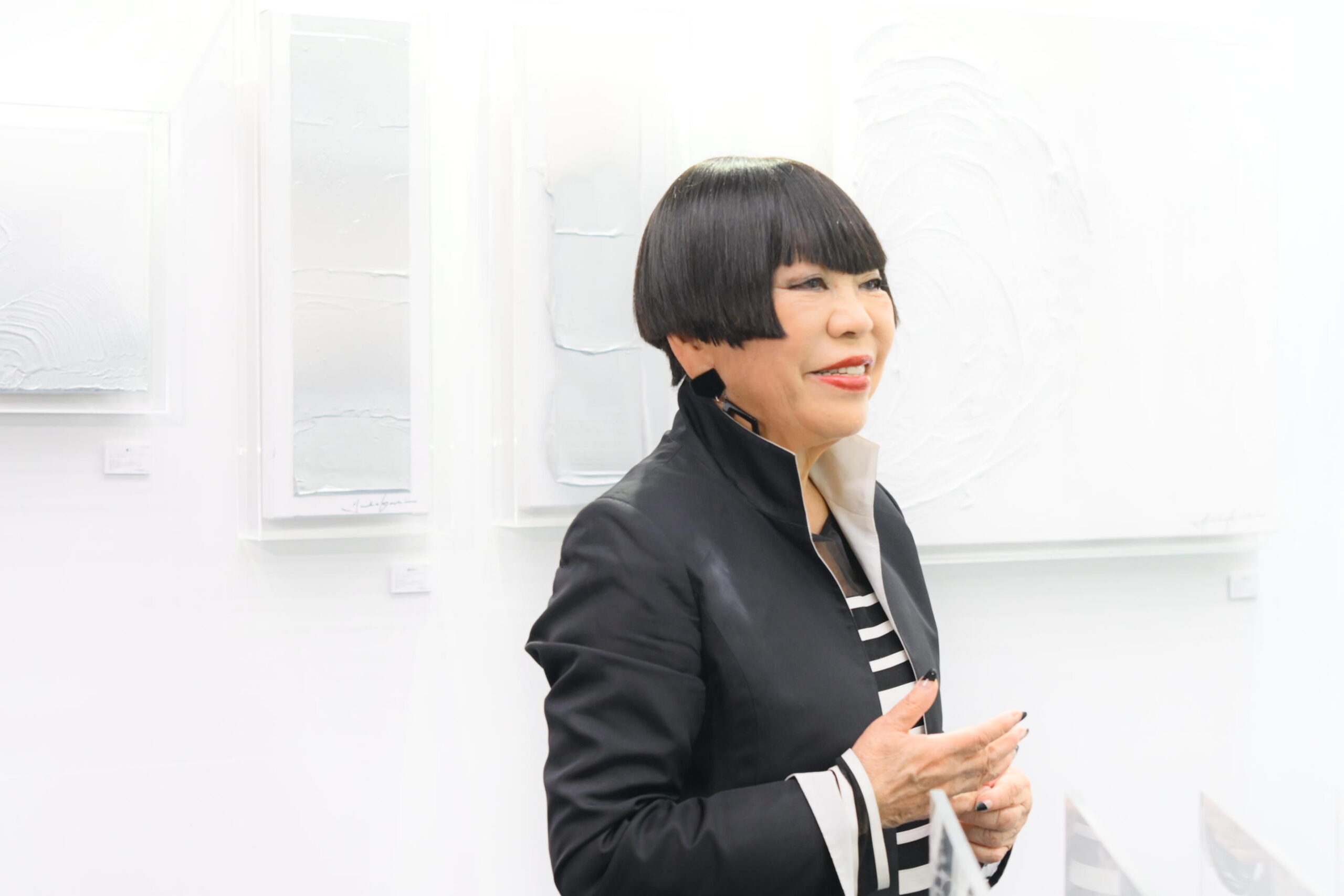
The district of Kabukicho — where light and shadow intertwine. Known as the largest entertainment district in the East, this area will soon host an all-night, roaming-style art event.
“BENTEN 2 Art Night Kabukicho,” running for three days from November 1, 2025, marks the second edition following last year’s “BENTEN 2024.” The event is curated by Chim↑Pom from Smappa!Group.
To uncover the real story and ideological underpinnings of the project, BAM conducted an exclusive pre-event interview — with Ryuta Ushiro, leader of Chim↑Pom from Smappa!Group, in Part 1, and Maki Tezuka, chairman of Smappa!Group, in Part 2.

A three-story installation composed of office furniture, lighting, and fixtures.
Photo: Kenji Morita / Courtesy of the artist, ANOMALY and MUJIN-TO Production
Held inside a Kabukicho shopping association building slated for demolition, where Mr. Tezuka serves as executive director.
A Rare Ecosystem of Art Emerging in Kabukicho
Could you start by telling us how this project came to be?
Ushiro: Chim↑Pom has always had deep ties with Kabukicho. I’ve collaborated with Mr. Tezuka on various projects — from organizing art events in the shopping association building, to holding a street wedding, and running something like the “Ningen Restaurant.” I also manage an art space called “WHITEHOUSE.”
Since the pandemic, many other art and cultural spaces have appeared around Kabukicho. Looking at all of them together, I thought, “A truly rare ecosystem of art is taking shape here.”

When I take international friends in art and music around these venues, they’re always fascinated by the district’s uniqueness. Art projects that gentrify nightlife areas have existed before, but what’s happening here is different — a bottom-up cultural emergence that’s drawing global attention. Spaces like Decameron, Shinjuku Kabukicho Noh Stage, and Ojo Building all opened during the pandemic. While Kabukicho was criticized as a “nightlife district,” that very stigma drew people and creativity toward it. It’s as if a magnetic field formed — while other areas froze, people gathered here seeking open spaces, starting new activity.
So that cultural soil naturally led to the idea of “BENTEN.”
Ushiro: Exactly. We considered a long-term “art festival,” but the scale and labor would be entirely different. And there are no museums here anyway. What defines Kabukicho are theaters, live houses, and street happenings. That’s why we thought something bodily, ephemeral, and nightlife-aligned made sense — and so the first “BENTEN” was born.
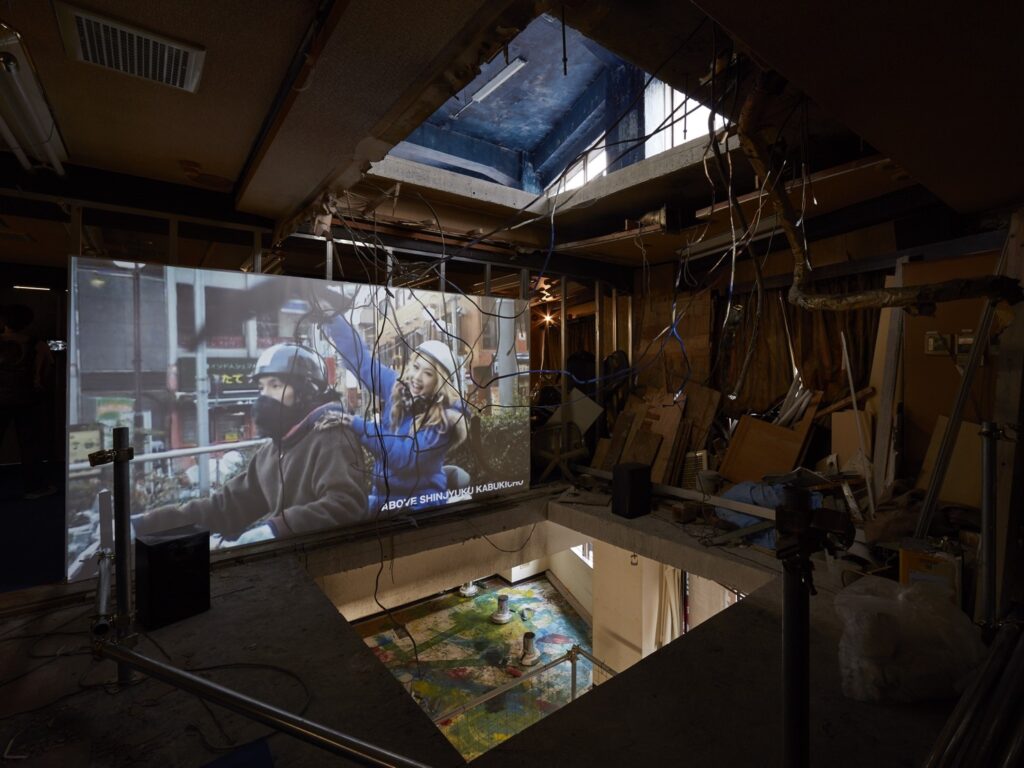
2008 / 2016 / video
Photo: Kenji Morita / Courtesy of the artist, ANOMALY and MUJIN-TO Production
Redevelopment and the Never-Ending Chaos
The theme for this year is “Urban Rewilding.” What does that mean?
Ushiro: The Ojo Building, Kabukicho Noh Stage, Decameron, and WHITEHOUSE — all began during redevelopment and the pandemic. Redevelopment is happening all across Tokyo, from Shibuya to other districts, bringing “order.” But in Kabukicho, redevelopment didn’t bring order — it generated more chaos. Yes, redevelopment drew more people, but Kabukicho being Kabukicho — it attracted wanderers, runaways, creators — birthing chaos. “This was a peculiar state of affairs unseen in other cities. I suspect that Kabukicho’s persistent, unchanged nature has a historical underpinning, and that is what I am considering as the theme for this project.

Photo: Kishin Shinoyama / Courtesy of the artist
The demonstration for “Love is Over” and the project inside the demolished building for “Mata Ashita mo Mite Kureru kana” were certainly impressive initiatives. But what are the distinctive features of “BENTEN”?
Ushiro: While we have positioned Miwa Yanagi as the main artist for this iteration, we feel that it is crucial for this art event to be much more multilayered and concurrent, rather than focusing on a single point. You won’t know what’s happening at which venue unless you wander through Kabukicho and let your eyes be drawn elsewhere. Not only contemporary art, but also performance, theater, music, club events, yokocho (alleys), bars, katsuben films (silent film narration), miso soup… all genres are intermingled, and the very timetable is a chaos of expression. Through this event, we want people to navigate and explore various parts of the town.
Bringing Kabukicho’s Locality to the World
Your collective is internationally recognized, and recently Kabukicho’s Golden Gai has also seen an increase in inbound tourists. How does that global dynamic connect to the event?
Ushiro: From a contemporary art perspective, Tokyo’s presence in Asia has declined in recent years. Hong Kong and Seoul have built ecosystems around international art fairs, with numerous satellite shows and parties. Taipei, amid political tension with China, has pushed artistic freedom further than ever. But importing Western formats wholesale, like in Hong Kong or Seoul, doesn’t suit Tokyo. This city has grown from subcultures and underground creativity, with an artistic lineage stretching back more than a century. “BENTEN” was conceived on that soil — guerrilla activities, bar-based creativity, underground art. It naturally became an event that emphasizes locality over globalized Western systems of fairs and museums.
The name “BENTEN” comes from Benzaiten, the goddess enshrined in Kabukicho Park, correct?
Ushiro: Yes. Benzaiten is a symbolic deity of Shinjuku — and a perfect icon for exploring the border between art and performance. Kabukicho is steeped in history and cultural hybridity. Rather than adopting Western frameworks, we wanted to showcase what’s already been cultivated here — and have it recognized as something inherently unique. Over time, I believe “BENTEN” will be internationally acknowledged as something singular — and I hope to keep experimenting with each edition.

Do you see “BENTEN” as a model or reference point for future projects?
Ushiro: Not really. I don’t think it will become a template or influence for other events. It only works because it’s Kabukicho. The methods, atmosphere, and logic are unique to this place. Other cities have entirely different dynamics.
So “BENTEN” is an expression that can only exist here.
Ushiro: Exactly. I’d like to deepen its “Kabukicho-ness” not just in expression but in operation too. That’s how it will become something truly without precedent — something the world has never seen.
The Intersection of Art and Entertainment: The Shinjuku Kabukicho Noh Stage
This year’s lineup includes musicians such as Naruyoshi Kikuchi — not just visual artists. What is your selection philosophy?
Ushiro: We’ve been working with Naohiro Ukawa from DOMMUNE since last year. Together with Yuko Yamamoto, he curates and books artists under the theme “Urban Rewilding.”From the beginning, I had DOMMUNE in mind. Their FREEDOMMUNE 0<ZERO> ONE THOUSAND 2013 was a massive, experimental music festival unlike anything else — deeply niche yet powerfully communal.
Likewise, in Japan’s crowded landscape of art festivals, it would be exciting if “BENTEN” occupied a similar countercultural position. Imagine Merzbow performing noise music in the middle of Kabukicho Cine City Square — that’s the kind of moment we hope to create.
Another important aspect is spatial — the Shinjuku Kabukicho Noh Stage may become a new identity for the district’s cultural activity. Artists like Miwa Yanagi and Chen Tianzhuo (of Asian Dope Boys) are both drawn to the existence of a Noh stage in such an unexpected location.
At first glance, a Noh stage in an entertainment district seems strange — but historically it’s quite natural. Kabuki and other performing arts originated from kawaramono rituals, from “wet” and liminal places like this. Having a Noh stage within a nightlife district — where deeply thought-out art unfolds — is crucial to exploring post–Western-centric expression. I hope “BENTEN” continues to evolve while cherishing that intersection of art and entertainment.
Through the cultural and temporal context of Kabukicho, Chim↑Pom from Smappa!Group has created “BENTEN 2 Art Night Kabukicho” — an event rooted in place and time.
What was once imagined as a “dangerous” or “chaotic” place reveals a completely new silhouette through their art. And that transformation touches both outsiders and those who live and breathe Kabukicho itself.
In the latter half of the article, we will unravel the thoughts of Maki Tezuka, who first stepped into this neighborhood as a host in 1997. Since then, as a ‘resident of Kabukicho,’ he has witnessed the true nature of the area—experiencing both the sweet and the bitter—and we will explore the future vision of Kabukicho that he envisions.
BENTEN 2 Art Night Kabukicho
The roaming art event “BENTEN 2 Art Night Kabukicho” will be held from November 1 to 3, 2025.
Under the theme “Urban Rewilding,” it is curated by Chim↑Pom from Smappa!Group, following the success of “BENTEN 2024.”Audiences can experience Kabukicho’s cultural pulse by roaming through venues such as the Shinjuku Kabukicho Noh Stage, Ojo Building, Decameron, WHITEHOUSE, and Tokyo Sabaku. Come witness the raw reality of this chaotic, luminous city firsthand.
Hours
November 1 (Sat) 15:00–05:00 / November 2 (Sun) 15:00–05:00 / November 3 (Mon, holiday) 15:00–23:00
*Hours may vary by venue.
Tickets
Advance tickets on sale now *Until October 31 at 11:59 p.m.
https://artsticker.app/en/events/94416
At the door:
1-Day ¥3,500 / Advance ¥3,000
3-Day Pass ¥7,000 / Advance ¥6,000
Under 18 ¥2,500 / Free for junior high school and under
After midnight: ¥2,000 (incl. 1 drink)
*Some programs may require additional fees.
Website: https://www.benten-kabukicho.com/
Instagram: @benten2025_kabukicho