At the very heart of Manhattan, New York, stands the Japan Society. Over the years, it has been home to exhibitions by world-renowned artists such as Yayoi Kusama and Takashi Murakami, leaving an indelible mark on the global art scene.
It was in this storied venue that Japanese manga artist and illustrator Acky Bright held his four-month solo exhibition, Acky Bright: Studio Infinity.
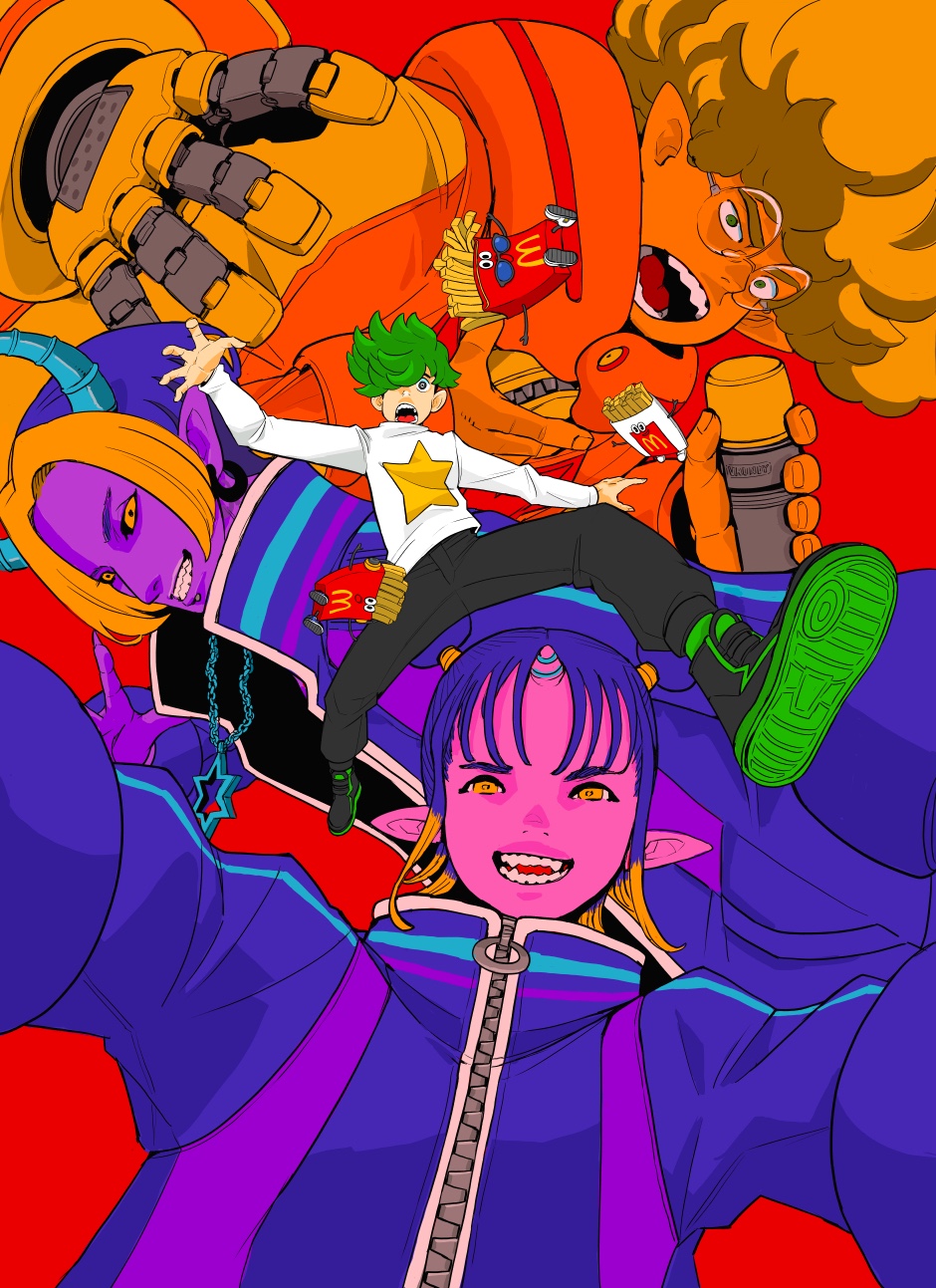
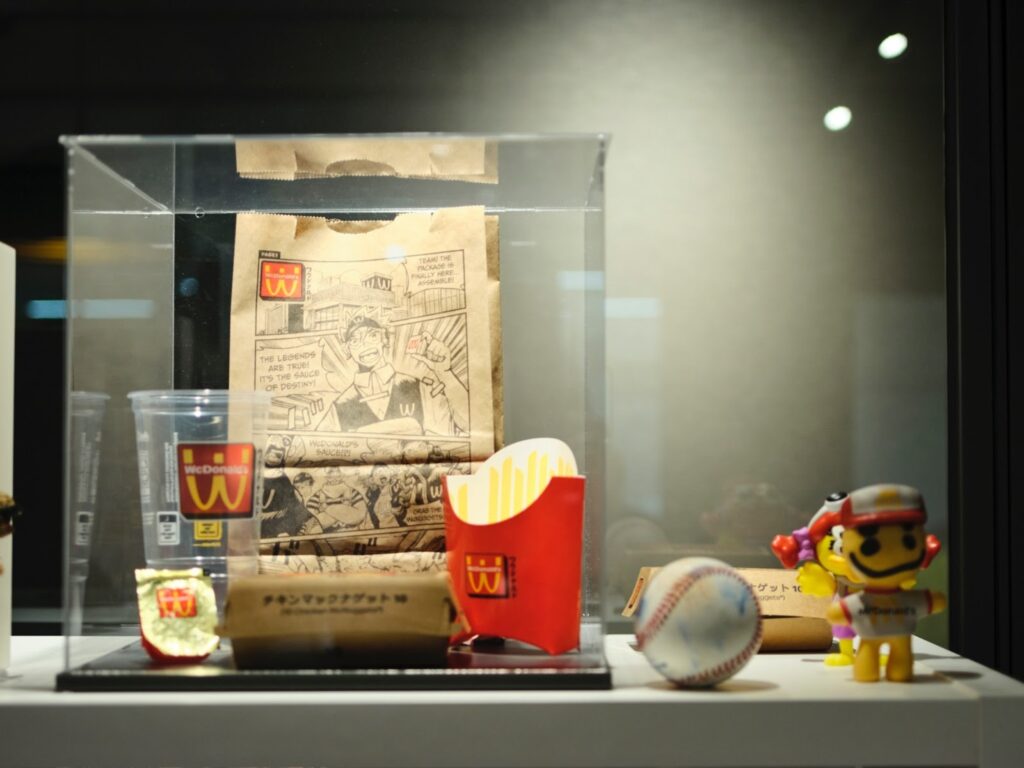
Having created comic variant covers for DC Comics and other major titles, Bright also made history through WcDonald’s, a global campaign rolled out by McDonald’s North America across 40 countries and regions. In the brand’s long history, he became the first individual artist to design the iconic McDonald’s paper bag.
Despite his growing international presence, Bright has now – almost in a reverse-import fashion – stepped decisively into the forefront of Japan’s creative scene.
In “Tiroli Mix,” a Japanese McDonald’s campaign that brought together some of today’s most influential artists, including Ado, YOASOBI, and Vaundy, it wasn’t only the music that captured attention and excitement. The original animated music video sparked widespread acclaim. After experiencing its overwhelming visual impact, viewers inevitably find themselves scanning the credits – and there, under character design, is his name.
“Art transcends language and borders.”
Acky Bright is often discussed for his distinctive style that moves fluidly between American comics and Japanese manga. Yet, as the conversation unfolds, it becomes clear that the future he envisions is far grander than any single genre or category…
It All Began Behind the Scenes

Acky Bright – Even before I started using the name “Acky Bright,” I was running my own design company. At the time, my main role was what you’d call a planner. I was involved in developing promotions, advertising campaigns, and event concepts for various companies. And in the course of all that work, there were always key moments when illustrations were needed.
And, you were drawing those illustrations.
Acky Bright – Yes, that’s right. I’d been drawing ever since I was a child and originally aspired to become a manga artist. Around high school, there was even a period when I had an editor from a publisher guiding me. But back then I was pretty sharp-edged, and honestly, I didn’t fully understand the situation I was in.
In the end, instead of becoming a manga artist, I found myself running a design company. Within the company, my role was firmly that of a planner. When it came to illustration, I never put my name on the work – I approached it completely as a behind-the-scenes job. It felt a bit like being a fixer, which was fun in its own way, and there was a sense of freedom that came from the lack of responsibility that anonymity allowed.
However, still, as the company grew, I began to feel there was something more I needed to confront.
Wait – The World Is This Interesting and Exciting?
Acky Bright – In 2017, or 2018 – about eight years ago, back when Netflix wasn’t nearly as big as it is now – I heard that Glee creator Ryan Murphy had signed a deal worth 30 billion yen over five years. Thirty billion yen, right? I remember thinking, “That’s Messi-level money” (though, to be fair, Messi probably earns even more).
It was a shock to realize that someone working as a screenwriter, in entertainment, could become the equivalent of Messi. But it wasn’t about wanting to make a lot of money or become famous.
Up until then, the budget allocation had been something like nine parts infrastructure to one part content. But despite investments in infrastructure continuing to increase, that ratio completely flipped. Infrastructure became one, content became nine. In other words, the overall scale of the budget itself was exploding by a factor of a hundred, it felt like.
That’s when it really hit me: “So this is how exciting things are getting in the world…”
From an infrastructure standpoint as well, things changed dramatically. For example, overseas viewers used to have no real way to watch Japanese TV anime except through illegal uploads or by waiting for physical releases. Suddenly, they were able to watch the same shows almost in real time; just like we could in Japan. The temporal and physical barriers that had existed between Japan and the rest of the world were all of the sudden, disappearing.
At the same time, with the pandemic and Japan’s economic situation, I was starting to feel the limits of working only within the domestic market. All of that pushed me to begin looking outward, toward the global stage. The normalization of remote work also played a huge role in making international collaboration feel not just possible, but natural.
That brought “Acky Bright” to life.
Acky Bright – Yes. I’d originally been drawn to planning work and had once aimed to become a manga artist because I loved creating something from nothing. I was still young, and the idea of working solely for money felt unfulfilling. So that was when I decided, for the first time, to start drawing under my own name.
“Acky Bright,” Born the Edogawa Conan Way
What’s the origin of your name?
Acky Bright – For my very first job in the U.S., I needed to be credited, which meant coming up with a pen name. I wanted something that sounded more foreign. People had always called me “Aki” as a nickname, so – kind of like Edogawa Conan – I thought I’d add something to “Acky.” I ended up attaching “Bright,” which was part of my company’s name at the time.
Another practical reason was visibility. At conventions and events, guest lists are often sorted alphabetically, and with an A and a B, my name would most likely appear near the top – which made it more noticeable and convenient.
How did you start once your name was set?
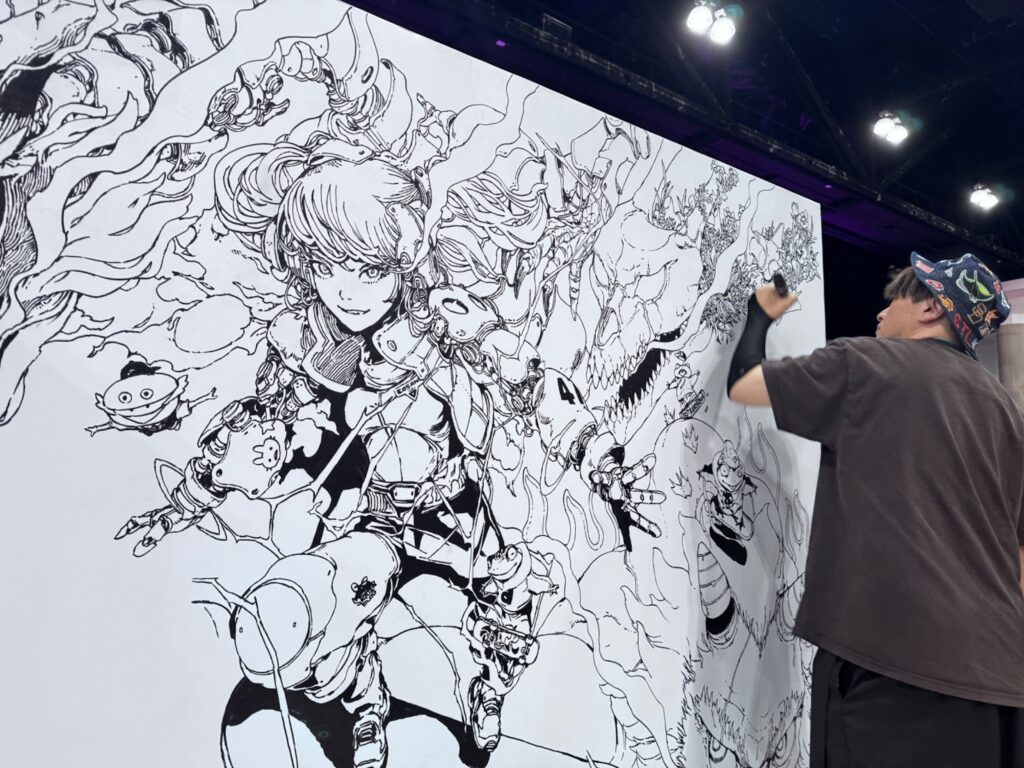
Acky Bright – At the time, I barely was on social media, so I started by posting illustrations every day on X and Instagram. Influenced by artists like Katsuya Terada and Kim Jung Gi, I also began participating in events and doing live drawing.
In 2021, I had the chance to do a live drawing session alongside Katsuya Terada, someone I had long admired. I don’t think I’ve ever been more nervous than I was then, and because of that experience, I stopped getting nervous at events of any size, in any country.
Going All In in America
What kind of projects were you involved with in America?
Acky Bright – The first job I landed after coming to the U.S. was an illustration for a Transformers T-shirt. It also meant a great deal that people like Paola Antonelli, a curator at MoMA, and Ben Abernathy, who at the time was Editor-in-Chief of DC Comics’ Batman group, believed in my work.
From there, opportunities began to snowball. I started receiving commissions from BMW in Germany, DC Comics, and for character design on WcDonald’s, a North American McDonald’s campaign. At DC Comics, I’ve also worked on spin-off projects featuring characters like the Joker, Harley Quinn, and KNIGHT TERRORS.
How did you think about drawing “comics” that exist within a different cultural context from Japanese manga?
Acky Bright – I’d loved manga and American comics ever since I was a kid. I did want to become a manga artist, but I never once imagined that I’d end up becoming a creator of American comics. When it came time to actually draw them, I honestly didn’t understand how the system worked at all. I’d always been on the viewer’s side – I knew Marvel and DC Comics as content, and I had a general idea about things like variant covers, but I knew almost nothing about what went on behind the scenes or how production actually worked. I had to learn everything step by step, simply by doing it.
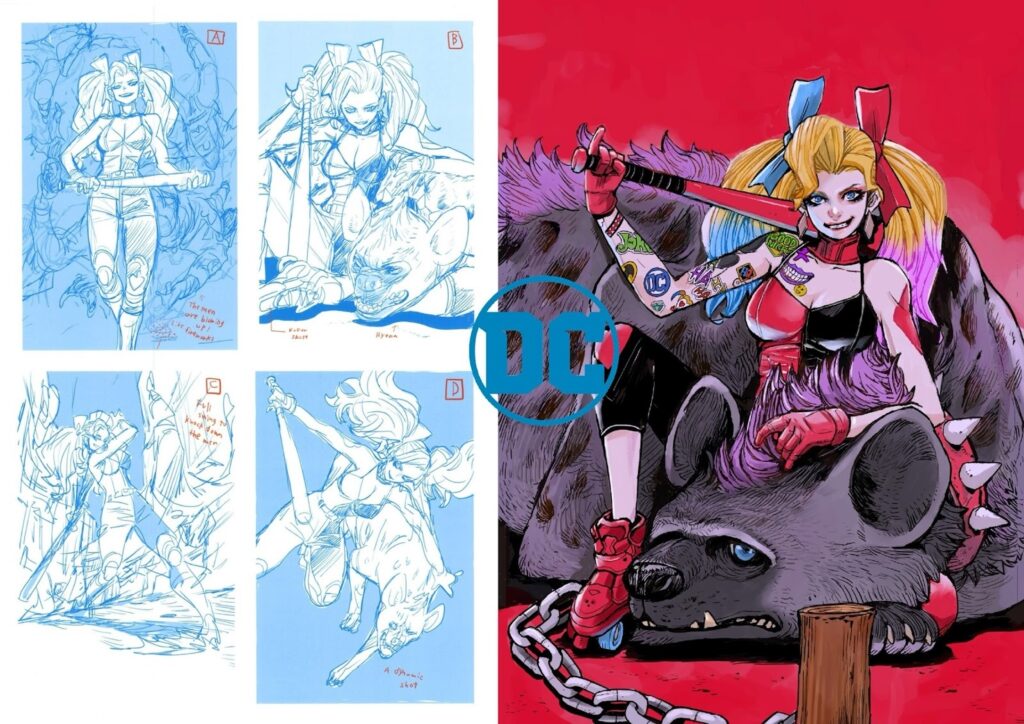
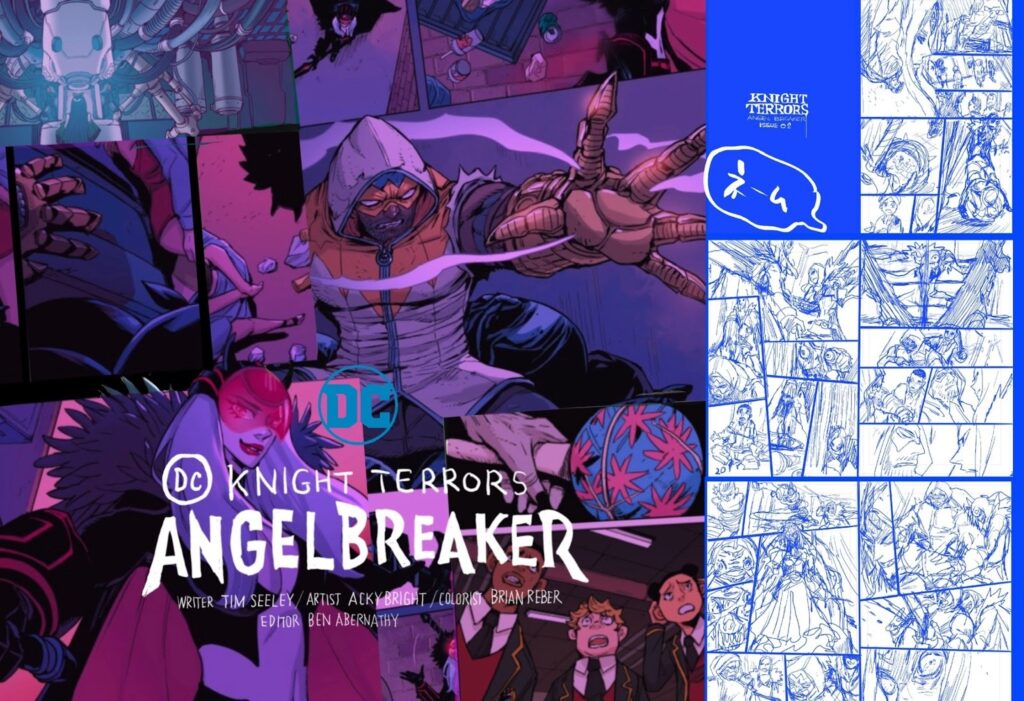
Sensing a Disconnect in “MANGA”
Acky Bright – When it came to seriously working overseas, being able to obtain a visa was absolutely crucial. I was granted one because my track record in North America prior to relocating was well recognized.
Visas are incredibly difficult to obtain, and working locally before securing one is considered illegal. Because the process overlapped with the pandemic, everything leading up to approval was handled smoothly via working remotely. Being able to build a solid track record in North America while still based in Japan was a huge advantage.
What was it like working on the ground after successfully securing your visa?
Acky Bright – Those three years on the ground were incredibly fulfilling. Having the visa meant I was free to work without restrictions. You often hear in Japanese media that anime and manga are completely taking over the world and that’s the narrative, right? And sure, if you go to an anime convention, it’s overwhelming. There are tons of fans. Even walking around the city, you’ll see cars covered in anime stickers, or people wearing Dragon Ball T-shirts.
But what I really came to understand by actually working there is that, on a gut level, the reality feels more like Japan 20 years ago. It’s still very much perceived as a culture for a specific group – what you’d call “otaku.” In Japan today, anime and manga have become fully mainstream. In that sense, I think there’s still enormous potential overseas. At the same time, I do feel there are real challenges, certain barriers that aren’t so easy to overcome.
Toward Manga That Speaks to the World’s Majority
Acky Bright – That’s exactly the goal I’m aiming for. Rather than simply exporting works made in Japan, if manga and anime are truly going to spread as global content, I believe it’s essential that the players, the creators themselves, increasingly come from outside Japan as well. In fact, I can feel the level and quality of MANGA and ANIME being created by overseas artists rising rapidly. Precisely because we’re reaching that stage, I think it’s incredibly important for people from all over the world to participate and help elevate this culture that originated in Japan. Recently, publishers have started to move in that direction too, but there are still challenges.
When it comes to working with MANGA or IP in the U.S., it’s not easy for publishers to have staff stationed there, sitting down face-to-face with creators and developing projects together. There are real limitations – walls, even a ceiling – to how far that can go. Within those constraints, I find meaning in immersing myself directly in the American scene and working from within it.
I’m currently preparing to set up a studio in North America, and that’s driven by this exact idea: I want to support artists from different countries in creating exciting work, from an artist’s point of view. That, more than anything else, is my ultimate goal, and my dream.
It’s a different dimension altogether from simply wanting to become more popular or to sell more of my own work.
Acky Bright – Yeah, I think so.
Ending Where It All Began—Behind the Scenes
Acky Bright – I started out in a behind-the-scenes role at a design company, and now I’m enjoying being on the front lines, putting my name out there. But ultimately, I want to return to being “behind the scenes” once again. I’ve always loved zero-to-one work – producing, planning, directing, taking command of the overall vision.
It’s not that I have no interest in finishing work, but there are countless people who excel at that. There are so many incredibly talented artists out there, far better than me in many ways. The asipiration is simply to work together with them. As for me, I’m more interested in opening up new spaces and pioneering something new. Like I mentioned earlier, I’m right in the middle of preparing to set up a studio in New York.
This is the first step toward returning to a behind-the-scenes role. That said, there are still areas where I’m not quite there yet, funding, track record, things like that. Right now, I’m fortunate to be receiving attention as a front-facing artist, so I want to push myself as far as I can in that role while I have the chance. And if where that path ultimately leads me is back to being “behind the scenes,” then I think that would be a good place to end up.
So you don’t have ambition in the conventional sense, as an artist?
Acky Bright – I think that’s true. Because ambition on its own isn’t enough to change the world. It would end with just my own satisfaction. At best, it would amount to nothing more than me being a little more popular than others and that’s where it would stop.
Toward a More Peaceful World Through the Power of Art and Contents

What prompted you to start thinking from such a broad, global perspective?
Acky Bright – I think it stems from the difficult, painful environment I grew up in as a child. What saved me during those tough times was manga, namely Jump, Magazine, and others. I would wait every week for the next issue to come out, thinking to myself, “I’ll keep going and ultimately, living.” Manga genuinely saved my life.
So in a way, this is my way of giving back. If there are people out there going through something similar to what I experienced, I’d be happy if manga could make the world, even just a little bit, a better place for them.
When Akira Toriyama passed away, people all over the world mourned him, without distinction. Isn’t that incredible? Toriyama, Dragon Ball – they transcend everything: religion, politics, all of it. Music and art are the same. Among fans, there are no borders – just people who love the same things.
There are many ways to contribute to society, but as someone who works in entertainment, I want to cherish and pursue that kind of contribution. That’s the mindset that drives me to base my work overseas and continue creating.
From the freedom of working anonymously behind the scenes, to stepping into the spotlight in search of meaning in his work – and ultimately crossing the ocean – Acky Bright’s journey led him to an unexpected realization: the global reach of Japanese anime and manga is still, in many ways, limited. In Part 2, we delve deeper into the fundamental differences between manga and American comics, Eastern and Western visual storytelling, along with the thinking behind his character design work. We’ll also explore how Acky Bright is working to bring Japanese-made culture into everyday life abroad, and how he envisions creative practice in the age of AI.