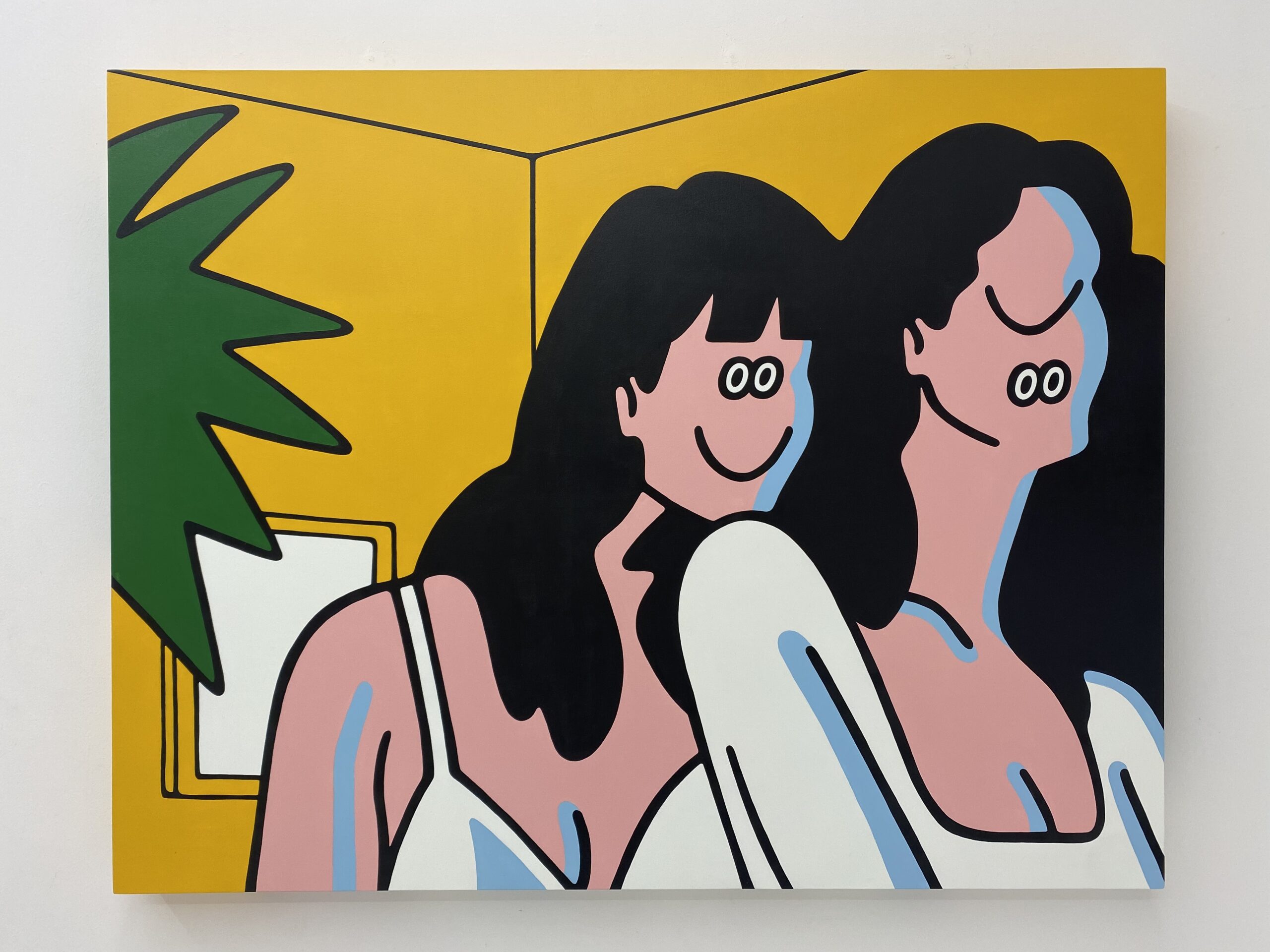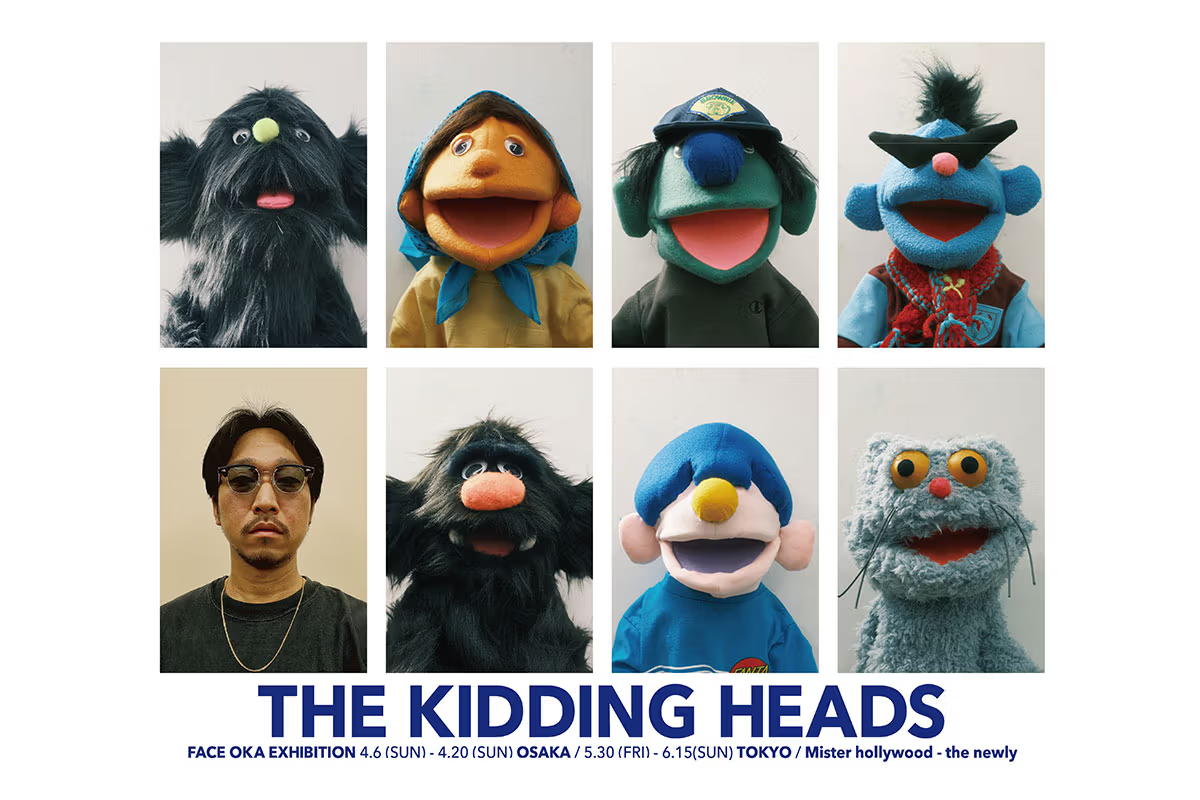
At one glance, anyone can recognize his work. The pieces are impactful yet surprisingly simple – one viewing is all it takes to make them unforgettable. His free-flowing and lateral style refuses to stick to just being an iconic illustration, and it all started by following the footsteps of artists he looked up to. The podcast “Too Young To Know,” which he co-founded with friends, has hit 173 episodes. Recently, he’s ventured into the puppet series “THE KIDDING HEADS,” operating them off-camera through his own voice and occasionally surreal movements.
So, who exactly is this artist?
We will be going deep across two parts – featuring “THE KIDDING HEADS” – to discover the answer.

Behind The Scenes of “THE KIDDING HEADS” – Operation
As a new project, you recently launched a puppet series “THE KIDDING HEADS.” Can you tell us more about it? Controlling the puppet seems quite challenging.
Face – Yes, I needed to practice the handling at first. Surprisingly, you get used to it after about a week. I usually set a fixed camera and film while I control them from below using my hands. Right around when I finished making one or two puppets, I watched the Netflix documentary “Being Elmo: A Puppeteer’s Journey” which features Kevin Clash, the voice actor of Elmo on Sesame Street. The film mainly focuses on how he became a voice actor, and didn’t really explain much about puppet handling itself but I watched the way puppet artists and instructors moved their puppets and thought, “Ah, I see how it works,” and learned by imitating them.

Do you also do all those distinctive high-pitched voices yourself?
Face – Yes, I do every part myself. I have a limited vocal range and so, basically I can only do a “high voice” and a “low voice” (laughs). This character has a higher voice, so that’s how I set it up.
Do you change the voice for each character?
Face – That’s what I try to do, but it is also my current challenge… At first, I wanted to create something like Mike Kelley’s poster work, which is why I initially decided to make seven characters and began working on them. But I never had a thought on the voices (laughs). As it turned out, I can only do about three different voices and right now, I’ve only given voices to Pablo, Petti, Jenny, and Picabia, who is modeled after my cat. For Picabia, it only says “meow” (laughs). These four characters have an established voice and appear frequently, but the other characters still need to have voices, which I’m currently struggling with sorting out.
Behind The Scenes of “THE KIDDING HEADS” – Character Development


Do they each have different personalities?
Face – Yes, they do. Though, I haven’t been able to fully develop it yet – it’s something that I want to work on more going forward. I’m creating a document that outlines each character’s personality and background, organizing it like a character proposal. My ultimate goal is to have a puppet show. It could be on TV, streaming services or YouTube. I want to create something that works as a proper series.
Are the characters a mysterious creature, or do they have more human-like nuances?
Face – Like Elmo, you can’t really identify them as a certain creature, right? It’s sort of like an animal but also abstract. I’m aiming towards something different and wanted to make “human puppets.” That’s where I intended to differentiate from others.

That’s different from Mike Kelley’s work too, isn’t it?
Face – Exactly. What I’m really drawing inspiration from is more like the old NHK show “Hatchpotch Station.” The show features characters that are supposed to be human. I love that worldview of “puppets in human form,” and I want to do something similar.
A Shocking Encounter with a Sewing Machine
Before “THE KIDDING HEADS” series, did you have any experience with using a sewing machine?
Face – This was my very first time using it properly – I had zero knowledge about sewing machines beforehand. When I decided to buy one, I didn’t even know where to get one, so I just went to Hands (formerly, Tokyu Hands). There was an older staff member there who seemed knowledgeable. I asked him about it, but he was very stubborn, saying “This one. This is the only one. Nothing else will do” (laughs). When I asked the price, it was around 400,000 yen, and I was quite shocked. But he also said, “It’s expensive, but it’s worth it.” I bought it feeling a bit skeptical, but when I actually used it, it was genuinely great. Usually with household sewing machines, the needle breaks when you try to use thick fabrics, right? Opposingly, industrial machines can be difficult to use with thin fabrics. But this machine is right in the middle as it can handle any material and it’s very versatile.

Is it a professional-grade machine?
Face – Well, that’s the mystery (laughs). Strictly speaking, it doesn’t feel like a professional machine. But it looks like one, right? When I first saw it, I thought “What is this thing?” The only place you can buy replacement parts is at Hands, and they’re expensive (laughs). Regardless of that, I still use it to this day.
Behind The Scenes of “THE KIDDING HEADS” – Production
You make all the puppets by hand yourself, correct?
Face – That’s right. I go to fabric stores and look for materials that match with the image in my head. At first, I wondered how to make them and tried researching, but there wasn’t much information online. As I kept searching, I came across something like a Japanese puppet association. It was a very old website but it provided a simple template so I bought it right away.
So you base your work on what the association provides?
Face – Yes. I follow the “correct” or basic method that the association provided, but only the foundation is the same and everything else is original. It is completely a trial and error in terms of giving each character individuality and uniqueness. To be honest, I bought the sewing machine on a whim about three years ago, so I started with almost no concept of patterns (laughs).

It sounds similar to DIY. Since we’re here, could you walk us through the process of making the puppets?
Face – I really struggled with making the heads. I had an image of the shape I wanted it to be, but I had no idea how to do so. Unlike sculpting with clay, creating a three-dimensional form with fabric was challenging. Through trial and error, I found a way to hand-sew the head parts.
What’s interesting is Pablo doesn’t have eyes or a mouth – just a nose, right? Most of your earlier works featured just the mouth and eyes, so this is king of the opposite – nose only.
Face – I didn’t have a particular intention behind it, but when I added the eyes, it personally didn’t feel right. That’s why I deliberately left them out – or rather, it felt natural to not include those features, and that’s how it ended up.
Am I able to touch it a bit? How’s the feet part done?
Face – The feet, I literally just finished these recently, and they’re yet to be painted. Structurally, they are sewn onto the upper body. It’s still at a prototype stage.

Looking closely at them, you don’t just put them in a simple hoodie, but you also dress them with T-shirts underneath and really pay attention to the small details.
Face – This character appeared in a commercial when I collaborated with New Balance in the past. At that time, I made it myself using iron-on prints.
The pin badges in the chest are also striking.
Face – About that, it’s because I simply love pin badges (laughs). This red one features a quote from an artist I like. I made it myself and put it on. The other one is a pin badge from a brand I like. With both, it feels like wearing my personal “likes”.
The shoes are cute too. These are…?
Face – At work, I recently received a doll that happened to be wearing these shoes. I thought “Oh, I can use these!” and just put them on the puppet without permission (laughs). The size was perfect as well. These kinds of coincidences are quite fun and I really like them.
A Crossing in Shinjuku and the West Ham Fan Greeting

Petti is wearing a West Ham football team uniform but are you by chance a fan?
Face – Yes, I am a West Ham fan. Which is why this puppet is dressed in this season’s West Ham uniform. I bought a children’s size set that comes with the top and shorts together.
So you’re the Irons (a fan name for West Ham)… That’s pretty niche, isn’t it? (laughs)
Face – It is (laughs). I have an acquaintance who travels abroad frequently for work, and I casually said, “Hey, let’s go to Spain sometime,” and they actually said, “Let’s go!” (laughs). At that time being, they had to go to London for work. Since I played football throughout high school, if we were going to London anyway, we were talking about going to the Premier League. But the thing was, the only Premier League tickets we could buy on the spot were for West Ham. I didn’t know a single player, but when we went, it was incredibly fun. Since then, I’ve been completely hooked. They’re currently second from the bottom and I hope they do better… (laughs)
I’m jealous…
Face – I often wear the West Ham scarf, and it was funny when a foreigner suddenly called out “Irons!” to me at a crossing in Shinjuku (laughs). (The team emblem of West Ham features crossed hammers, and fans apparently greet each other by crossing their hands.) I was an actual fan, so I’m glad I was able to respond immediately (laughs).
Will Face Remain in Art History?
Previously, you’ve mentioned that you would like to “remain in art history” and “be collected by museums.” Do you still feel the same way?
Face – Of course, that hasn’t changed. But, looking at the current art industry, I do feel somewhat distant from it. There was an art bubble a while ago, and during that time, there was hope that “maybe our art could rise a bit higher in position.” However, when the trend settled, I didn’t really feel that possibility anymore.
During the so-called “art boom,” the way things were bought and the market’s energy were quite unique, weren’t they?
Face – Right. When I think about the customers during the boom, I believe people’s view of art was rather “investment” than pure appreciation. For example, it would become a hot topic when something “sold out completely!” while “who bought it” was never included in the talk. Considering that, I personally wonder if that was really a meaningful purchase. If the work doesn’t end up in the hands of the fans of the piece or the artist, then it feels a bit different to what I want to do. So now, as the bubble has settled and I rethink about it, my ultimate goal of “remaining in art history” has become more distant – or rather that I’ve recognized “it was far away all along.”
Coming from you, whose style is deeply influenced by your “admiration” towards various artists, that’s really convincing.
Face – It’s not just about the price tag, but about how you’re evaluated and how you remain in the industry. Rather than having my name on the history, I hope it develops in an interesting way that the work itself “remains with meaning.” So the goal of “remaining in art history” is still there, but I can’t really visualize it in detail. And right now, I also feel that being too conscious of it may not be the best. As I pursue what I want to do, I wish the timing also works out and things fall into place nicely.
KAWS, James Jarvis, Mike Kelley, Barry McGee… The artistic path he’s followed in pursuit of these figures. Where will Face Oka head as he surpasses these “idols”? His boundless creative activities are impossible to take your eyes off.