Since its serialization began in 1981, Captain Tsubasa has been translated and broadcast in over 100 countries worldwide. Its history has run almost parallel to the history of Japanese football itself. The generation that grew up alongside the birth of the J.League — kids who once mimicked “Tsubasa-kun’s” moves on the pitch — are now grown, playing for the national team or working as commentators.
And in 2026, that story is finally setting off on a journey around the world in a brand-new form: art.
Captain Tsubasa One World One Team Art Exhibition 2026
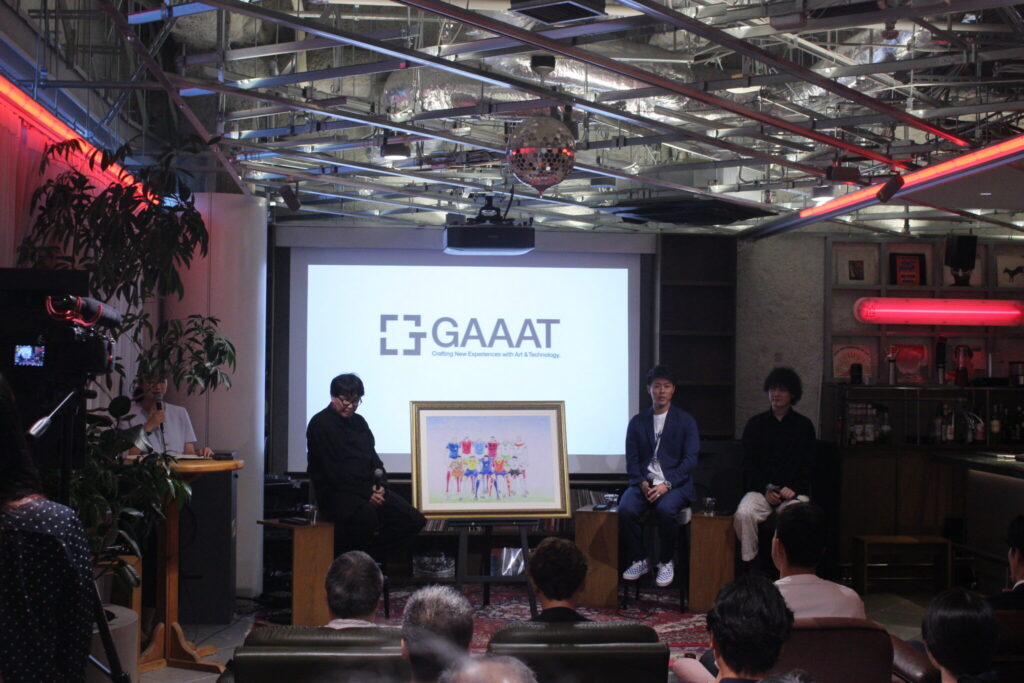
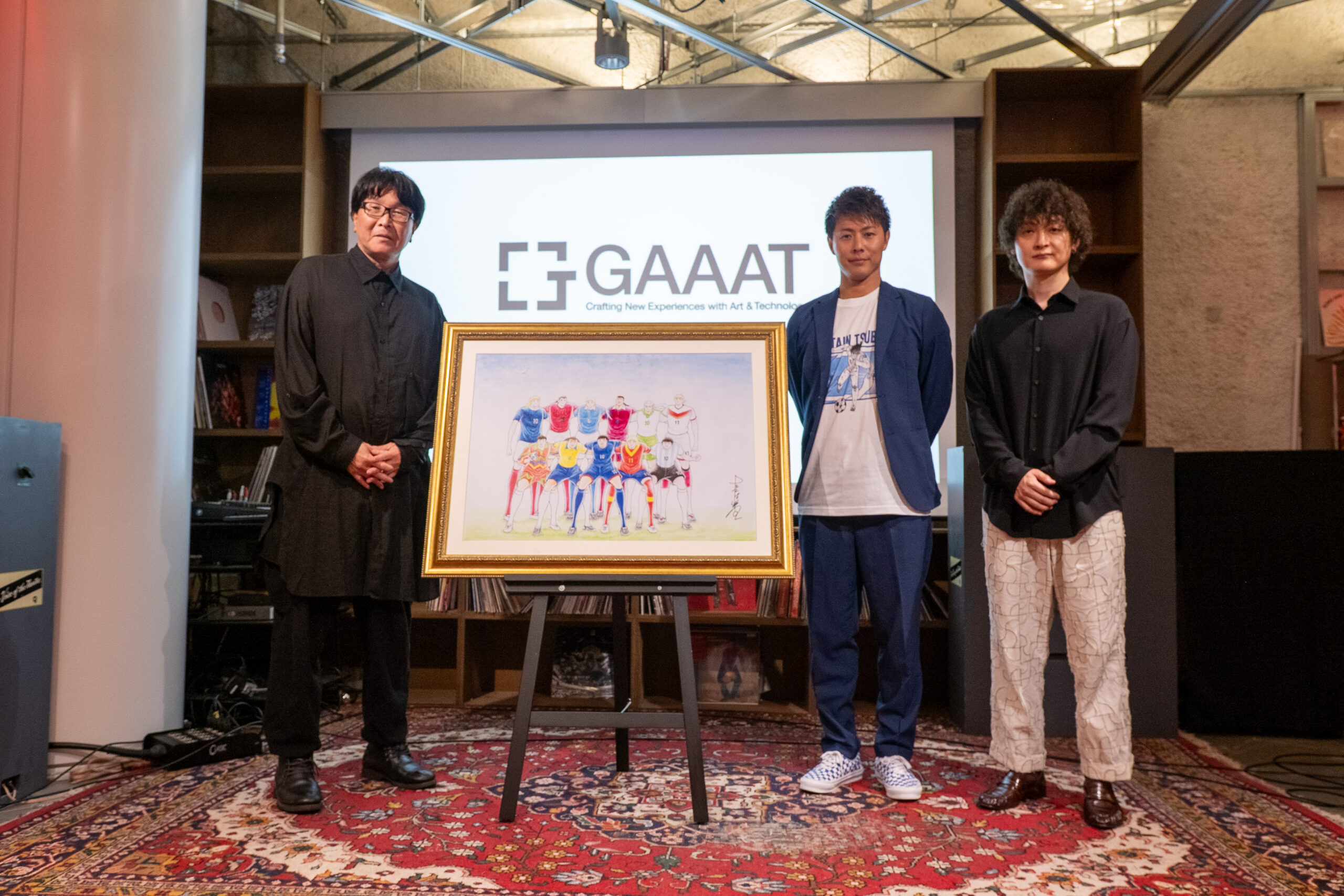
To mark this project — which kicks off in San Francisco before traveling on to New York, Singapore, Hong Kong, and Europe — we sat down with manga artist Yoichi Takahashi, former Japan national team player Yoichiro Kakitani, and Yusuke Tokuhashi, CEO of GAAAT Inc., the company behind the project. Three generations who’ve all walked alongside “Tsubasa-kun” came together to talk about football, art, and everything in between.
Where It All Began — When IP Meets Art
Could you tell us how this project came about?
Tokuhashi: At GAAAT, our whole business is about combining IP with art to create new form of art. In that spirit, we launched a project to bring Captain Tsubasa to the world in the form of art. The newly created pieces for this exhibition are limited to just 11 editions worldwide — once they’re gone, that’s it.
Mr. Takahashi, how does it feel having an art exhibition built around your work in this way?
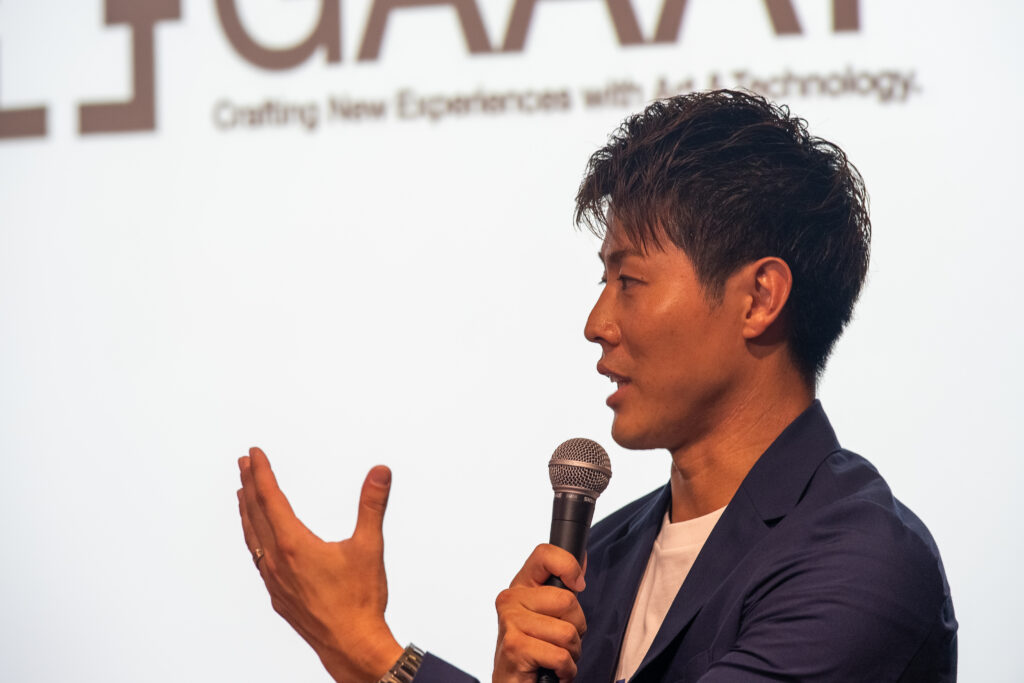
Takahashi: I’m truly honored that this work was chosen. Captain Tsubasa has readers all over the world, and I’d be thrilled if it could reach them in this new form — as art.
Captain Tsubasa Was Always by My Side
Mr. Kakitani, what has Captain Tsubasa meant to you?
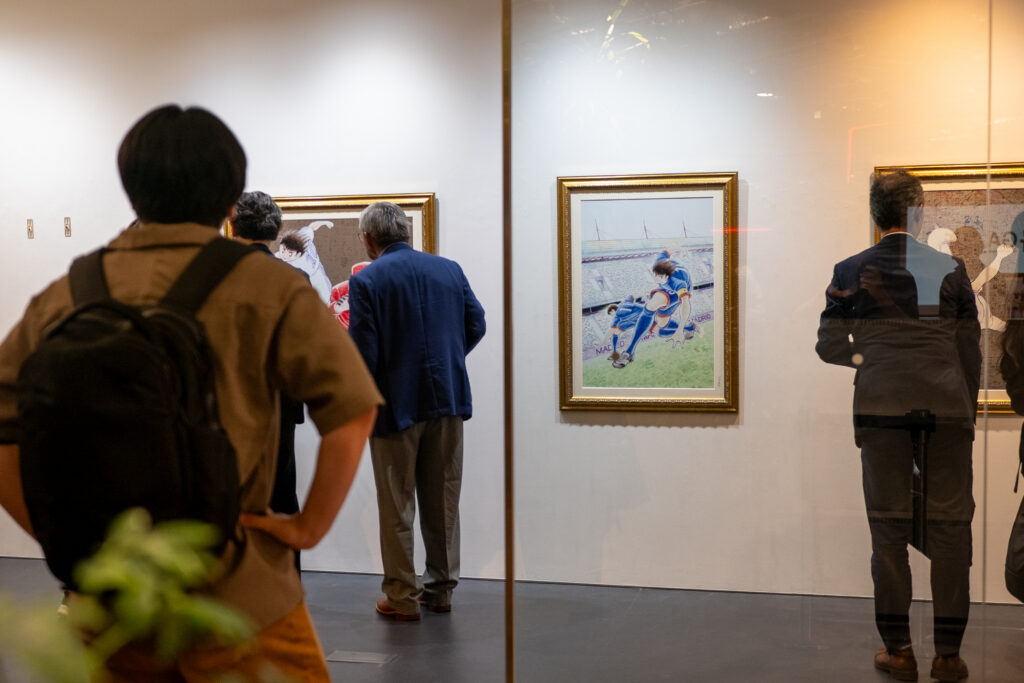
Kakitani: I always loved acrobatic plays and overhead kicks. But it wasn’t really that I was “trying to be like Tsubasa” — it was more that the plays I loved happened to be the same ones packed into Captain Tsubasa. Honestly, as a kid I practically claimed the name “Tsubasa” as my own (laughs). That’s how close the series felt to me.
Are there any characters that have stuck with you?
Kakitani: Tsubasa, of course — but characters like Misaki matter just as much. Tsubasa could never have become “Tsubasa” on his own. During my playing career, I always played alongside Shinji Kagawa and Takashi Inui, and those two felt a lot like that kind of presence to me. There were times I thought, “I wish I’d had a Misaki of my own.”
Having teammates is what makes individual stories come alive. Tsubasa became Tsubasa precisely because he wasn’t alone — and honestly, that’s something I envy a little. It’s the part that stayed with me most: “That’s the kind of player I wanted to be.”
The Era When Football and Manga Pushed Each Other Forward
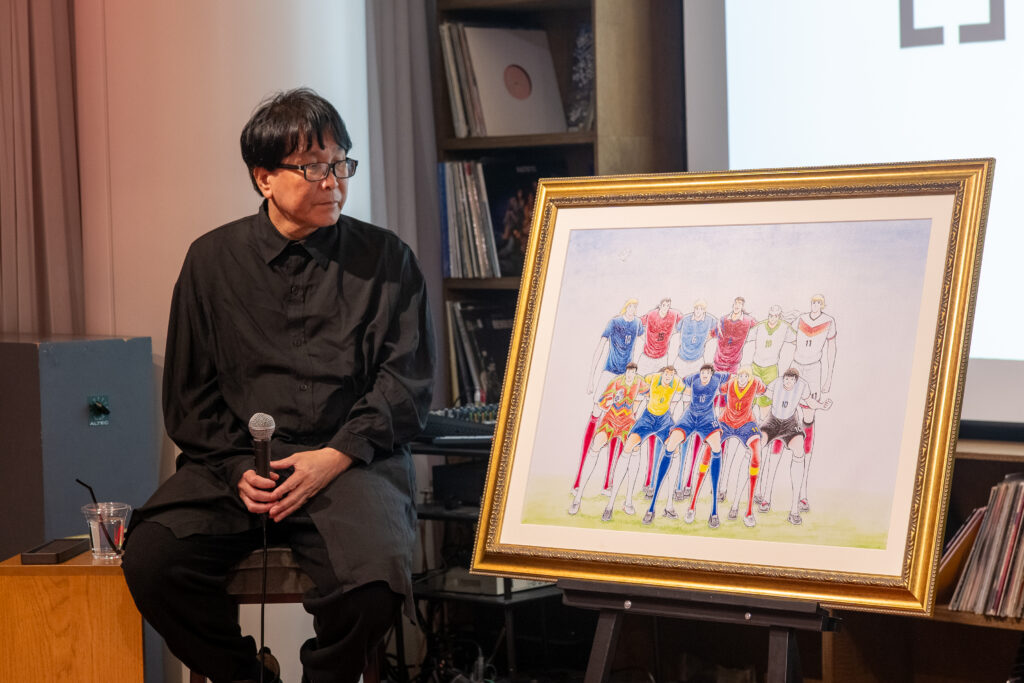
Back when you started drawing this series, people said the plays in the manga went beyond what was possible in real life. How does it feel now that today’s players are actually pulling off those moves?
Takahashi: It really makes me happy. When I was drawing, I always thought, “I want to see a play like this” — and now, every time a real player pulls off something close to that, it gets picked up and celebrated. Every time, I think, “Yes — this is what I wanted to see.”
Kakitani: During training, there was always this feeling of “Sensei drew it, so we have to try it” (laughs). I really don’t think Takahashi-sensei ever drew anything truly impossible. Inside his head, he’s the greatest fantasista of all — and players try their best to live up to that imagination. Getting told “that was just like Tsubasa” became its own kind of motivation. Honestly, there were times I wanted to pull off plays even Takahashi-sensei hadn’t drawn (laughs).
The 2026 World Cup — What Do You Hope to See from Japan?
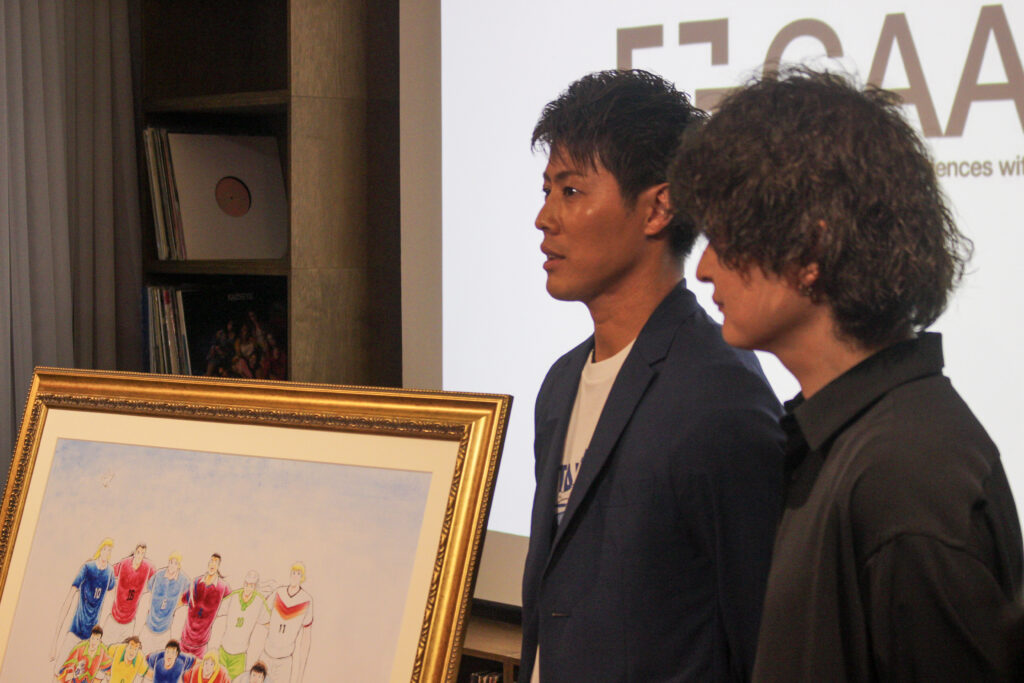
The FIFA World Cup 2026 is right around the corner. What do you hope for from the Japan national team, Mr. Kakitani?
Kakitani: I want to let go of thinking like “let’s just get through the group stage” or “making it to the quarterfinals would be great.” If the players themselves are saying “we’re going to win it all,” then we as supporters need to be ready to share that same view and picture the best possible outcome with them. The players aren’t the only ones in this fight. All we can do is believe in the 26 chosen players.
Mr. Takahashi, is there a player you’re keeping an eye on?
Takahashi: Kaishu Sano. He’s really coming into his own right now, and I think he’s having a huge impact. There’s a sense that this team could really hinge on him.
What do the two of you most want to see throughout the tournament?
Kakitani: Within those 90 minutes, there are countless moments that move you regardless of the score. Beating a defender with a brilliant piece of skill doesn’t put a point on the board — but that moment still moves you. People say that in today’s era of highly organized football, there are fewer and fewer players who can break out of the script like that. That’s exactly why I want to see players like France’s Shérki, who’ll try a piece of skill or a rabona mid-match. If this tournament has moments where a standout individual really shines, that’s what I’m looking forward to.
Takahashi: Football has trends, just like fashion. Once organized football becomes the standard, a new style emerges to break it down — and I think we’ll see that cycle play out again at this World Cup. A standout individual player could come along and shift the tide once more. I’d love to see that kind of new, different football.
A Message of World Peace, Captured in a Single Piece
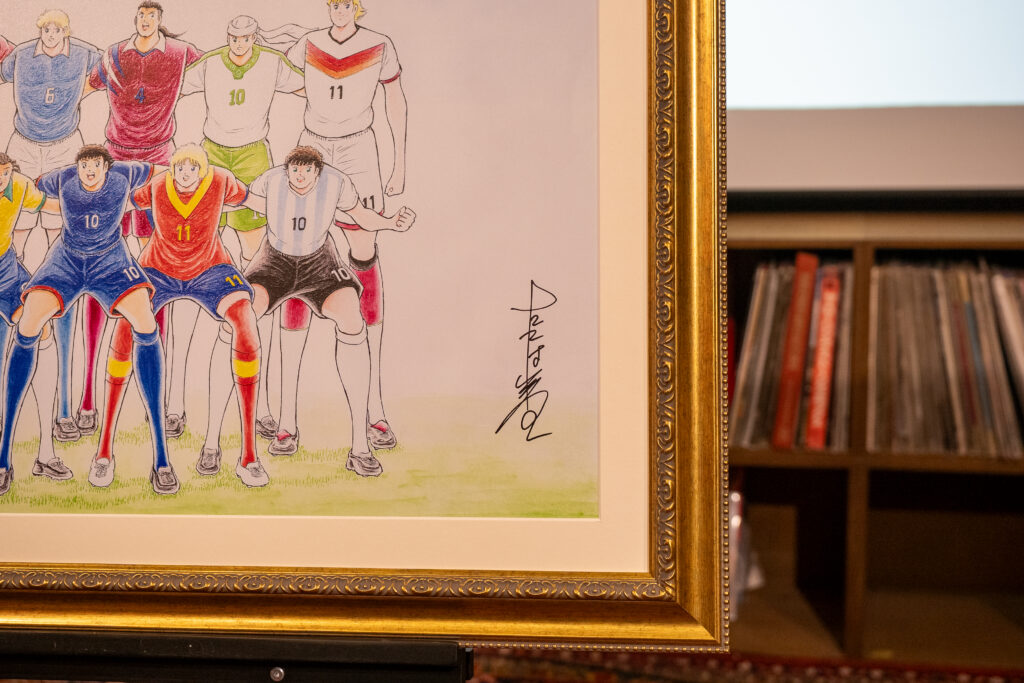
Mr. Takahashi, could you tell us about the thoughts behind this newly created piece?
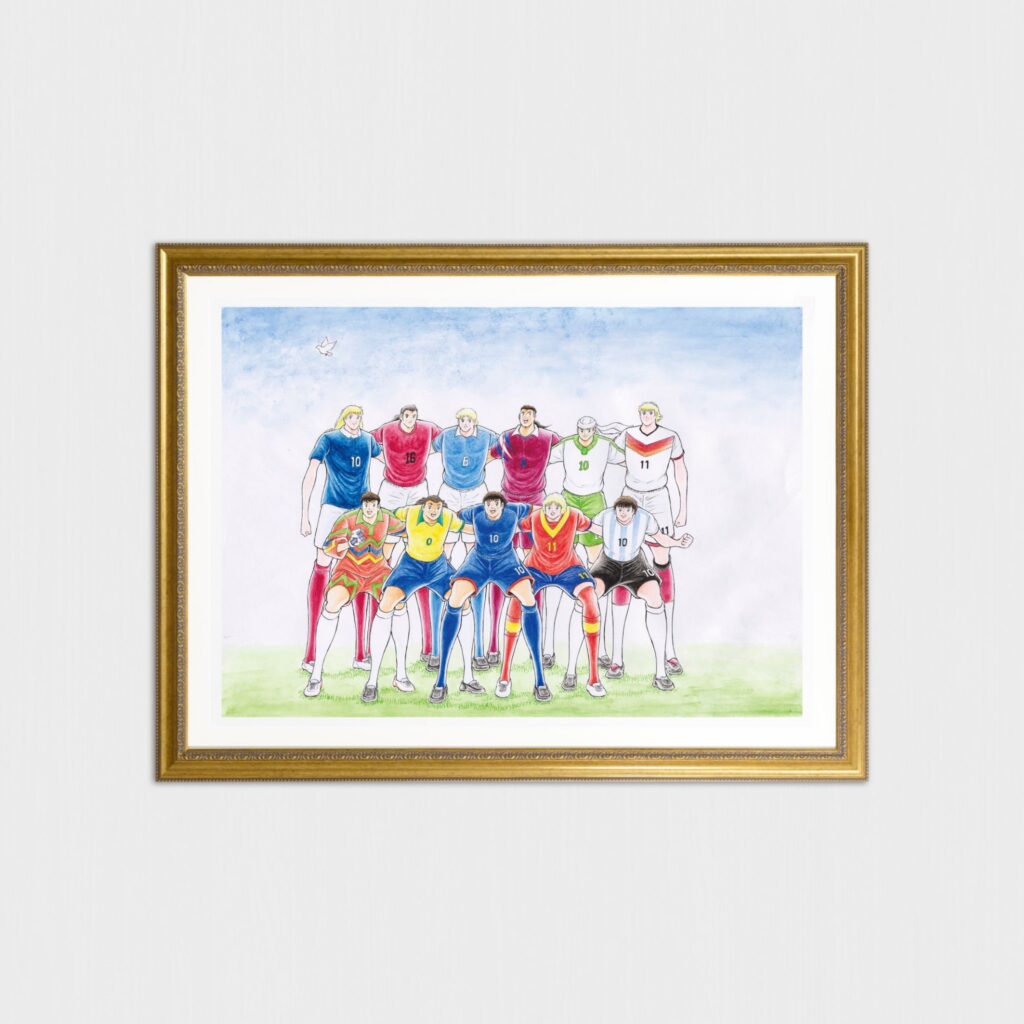
Takahashi: The theme this time is “world peace.” With war happening in various parts of the world right now, I’ve had this persistent feeling of just… not wanting that. World peace has always been one of the themes running through the Tsubasa story. This time, I wanted to put that feeling into a single illustration — a wish for people all over the world to get along. On the pitch, of course, everyone gives their all to beat the opponent — but once the match ends, players can recognize and respect each other. I wanted to capture that beautiful moment that’s unique to sport. I did wonder if I should have drawn more than 11 people, but football is a sport played by 11 — and this piece is also limited to 11 editions worldwide. So I settled on 11.
Mr. Kakitani, what did you feel when you saw the finished piece?
Kakitani: The dove in the top left is so cute (laughs). But seriously — “world peace” is such a huge concept. Words alone often don’t get it across. But just looking at this piece, you feel that sentiment. For us, as football players, the pitch is a place where race and borders don’t matter — you just get completely absorbed in the game. This piece somehow captures that feeling in a single image.
The Tension of a Single Image — Manga vs. the “Frozen Moment”
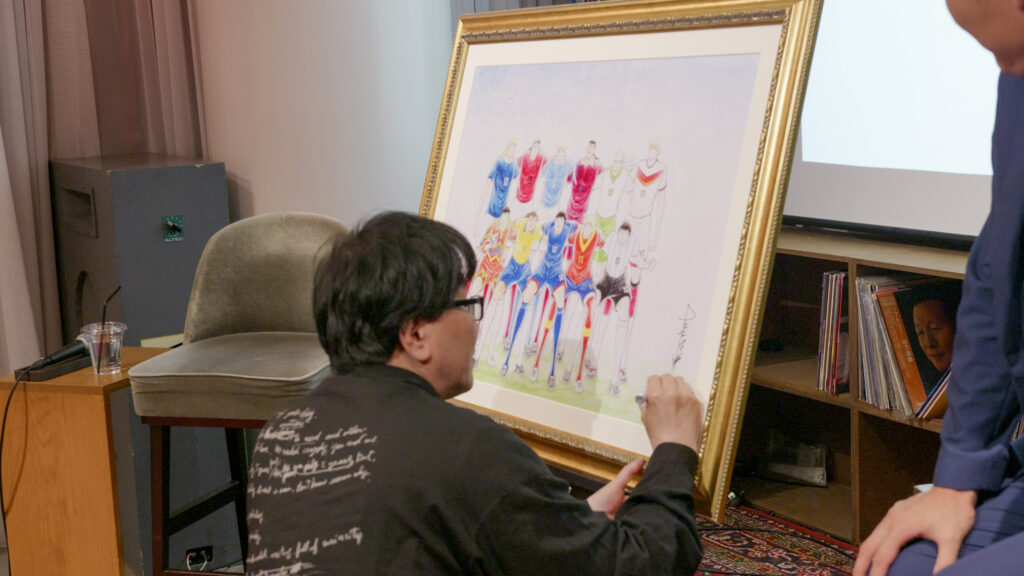
With manga, turning the page creates a sense of motion and energy. Capturing that in a single still image must come with its own challenges. Could you tell us about how you approach that, and what you envision for your future art activities?
Takahashi: In manga, the movement of a play can unfold across a sequence of pages — there’s a flow to ride along with. But with a single image, everything has to be condensed into one moment. So the real challenge is choosing exactly which moment to capture — that choice becomes everything. Every detail, from composition to facial expression, has to be pushed as far as it can go. With regular manga, I’m always thinking about the flow before and after a scene, so in a way, you can ride that momentum. But a “frozen image” like this doesn’t have that luxury — which makes it more tense. I approached it wanting to obsess over every detail and land on a single image I could be truly satisfied with.
Manga’s Journey into the World as “Art”
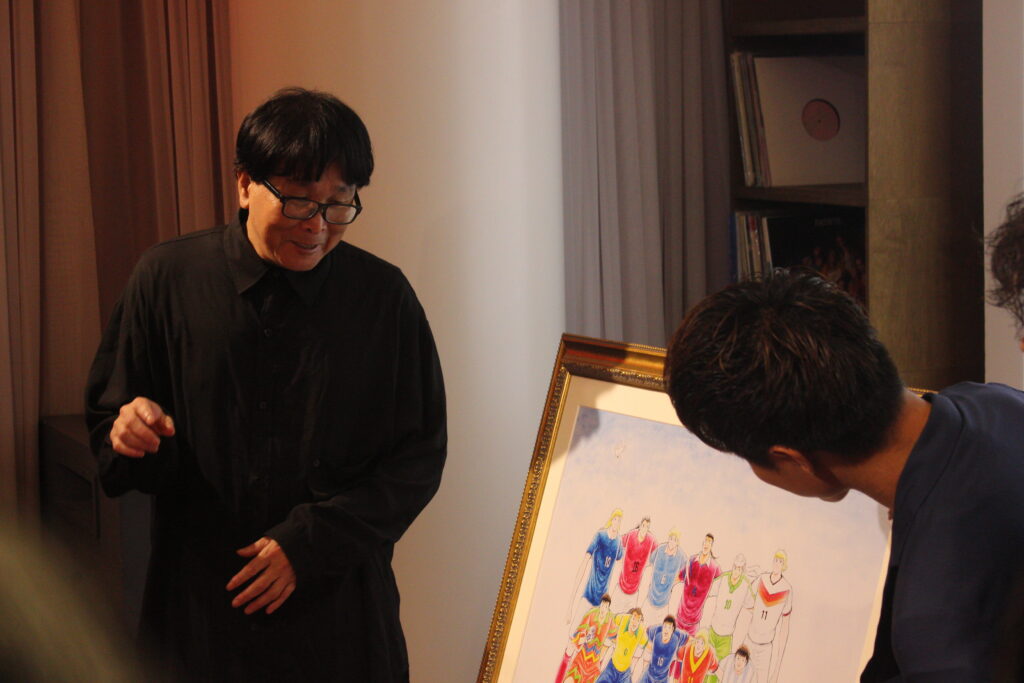
How does it feel to have your manga travel the world as works of art?
Takahashi: Manga has historically been looked down on a bit, even within the world of art. But I’ve poured my heart and soul into this work, day after day — and now it’s being recognized as art and presented to the world. Touring exhibitions around the globe has always been one of my dreams, so as a manga artist, this means a great deal to me.
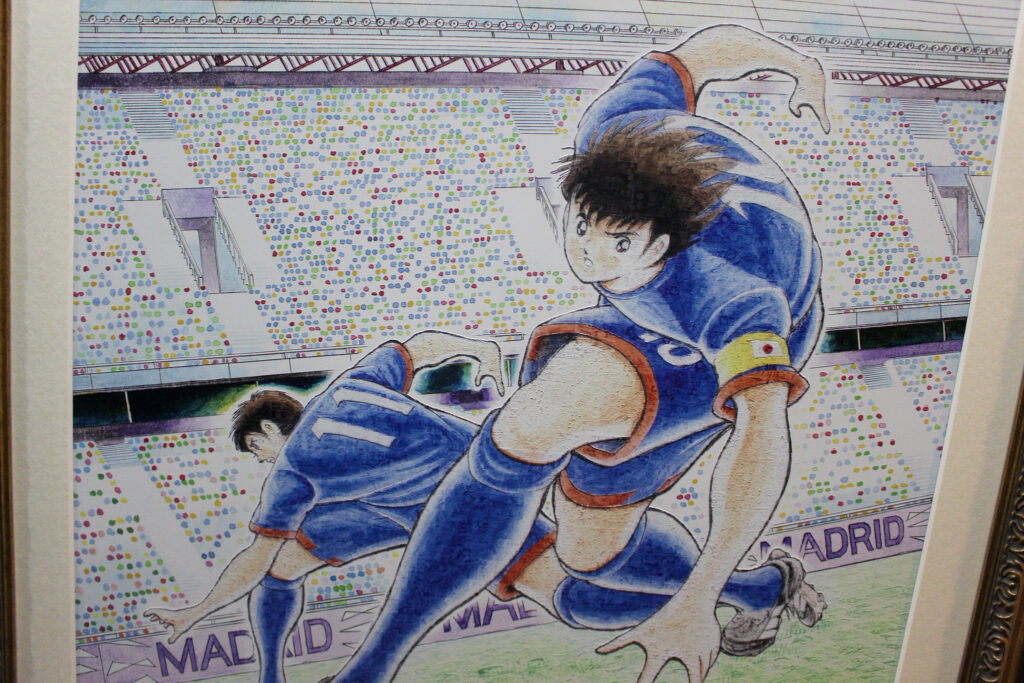
For this project, the pieces I normally paint in watercolor have been processed using a special technique called MCA (Metal Canvas Art), built up in multiple layers. The texture and depth come through almost like an oil painting, and the durability has been carefully engineered too. It’s a completely different format from ordinary prints.
Across Eras and Borders, Out into the World
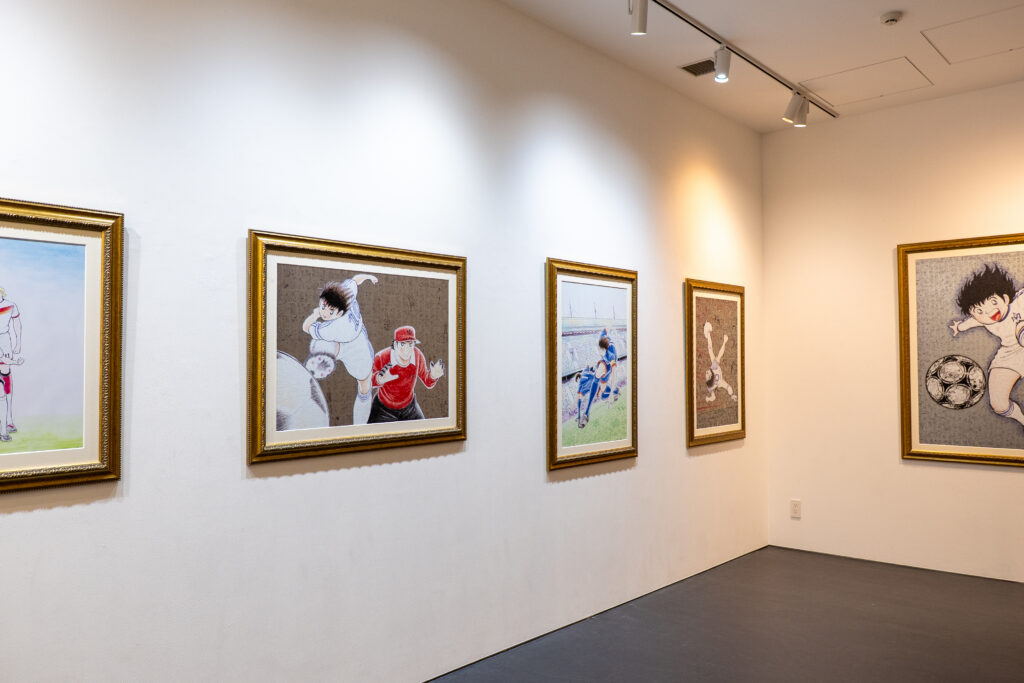
Is there a particular message or feeling you want this exhibition to convey?
Kakitani: I think Captain Tsubasa is always somewhere in the background as kids fall in love with football. The names of the moves, the special skills each character has — as adults, you start to realize, “wait, some of that’s actually possible” (laughs). But as a kid, you’re just purely amazed and want to try it yourself. I want to keep passing that world of Captain Tsubasa on to kids — showing them, “this move exists, this world exists.” I’d be thrilled if even one more “Tsubasa-kun” type of player comes out of that.
Takahashi: Captain Tsubasa has always been manga — meaning art and story together, as one. I’m really happy that this time, that combination is colliding with football and art and being sent out into the world. I hope people don’t just see these as illustrations, but feel the story of Captain Tsubasa itself through the art. I really hope this message reaches people all over the world.
The 2026 FIFA World Cup is now just around the corner.
Thirty-five years since the J.League’s founding in 1991, Japan’s dream of winning the World Cup has been blocked by the wall of the Round of 16 — four times. Can SAMURAI BLUE, hailed as their strongest squad ever, finally break through that wall and see a new horizon?
“Winning the World Cup… for Japan, that might be a dream that never comes true… but we… we…”
With the hope that Tsubasa’s dream becomes reality.
Captain Tsubasa ONE WORLD ONE TEAM Art Exhibition 2026
Project Overview Kicking off with two cities in the United States, this exhibition will tour a planned 11 cities worldwide. Alongside newly created works by Yoichi Takahashi, the show will feature pieces reimagining the world of Captain Tsubasa as MCA (Metal Canvas Art), along with related merchandise. Details on venues, dates, sales formats, purchase conditions, and VIP access for each city will be announced on the official landing page as they’re confirmed.
San Francisco Exhibition
Dates: Saturday, June 13 – Sunday, June 21, 2026
Venue: GCS Agency Address: 236 Powell St, San Francisco, CA 94102, United States
Hours: 12:00 PM – 6:00 PM
New York Exhibition
Dates: Sunday, July 19 – Tuesday, July 21, 2026
Venue: Jutta Gallery Address: 104 Charlton St #1E, New York, NY 10014, United States
Hours: 12:00 PM – 6:00 PM
For details on sales formats and purchase conditions, please see the official page: https://gallery.gaaat.com/en-us/pages/captain_tsubasa
Other Planned Locations (venues and details to be announced)
Note: Dates and locations below are tentative and may change depending on global circumstances. Singapore: August 2026
Hong Kong: September 2026
Berlin: October 2026
Milan: October 2026
Paris: November 2026
Barcelona: December 2026
Taipei: December 2026
Dubai: December 2026
Tokyo: January 2027
Featured Works (Selection)
The exhibition features 17 works in total, No.001–No.016 plus a Commission Work.
Featured below: No.001 / No.002 / No.003 / No.005
No.001 — Captain Tsubasa (1 of 1 worldwide)
Sale: Web auction in New York (planned)
Edition: 1 (Unique, original work)
Size: 1,470 (H) × 1,180 (W) mm
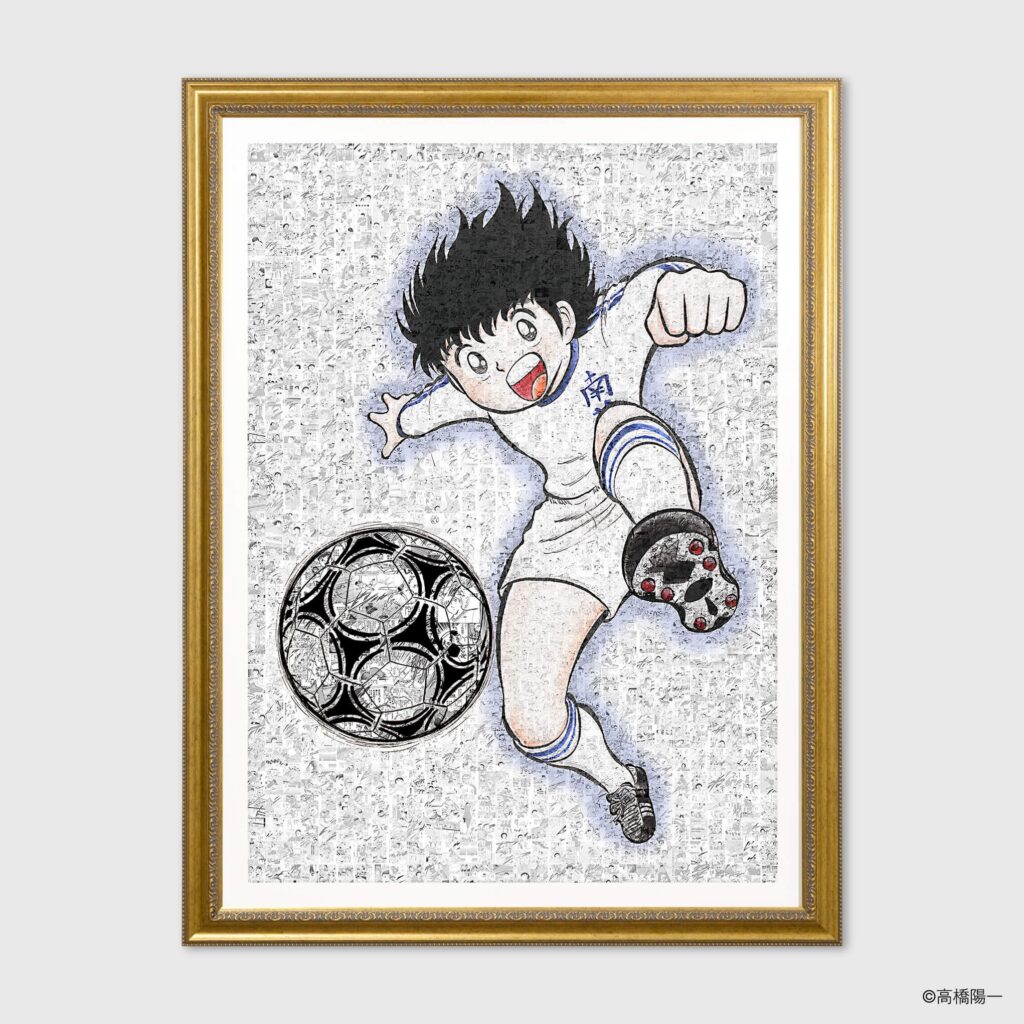
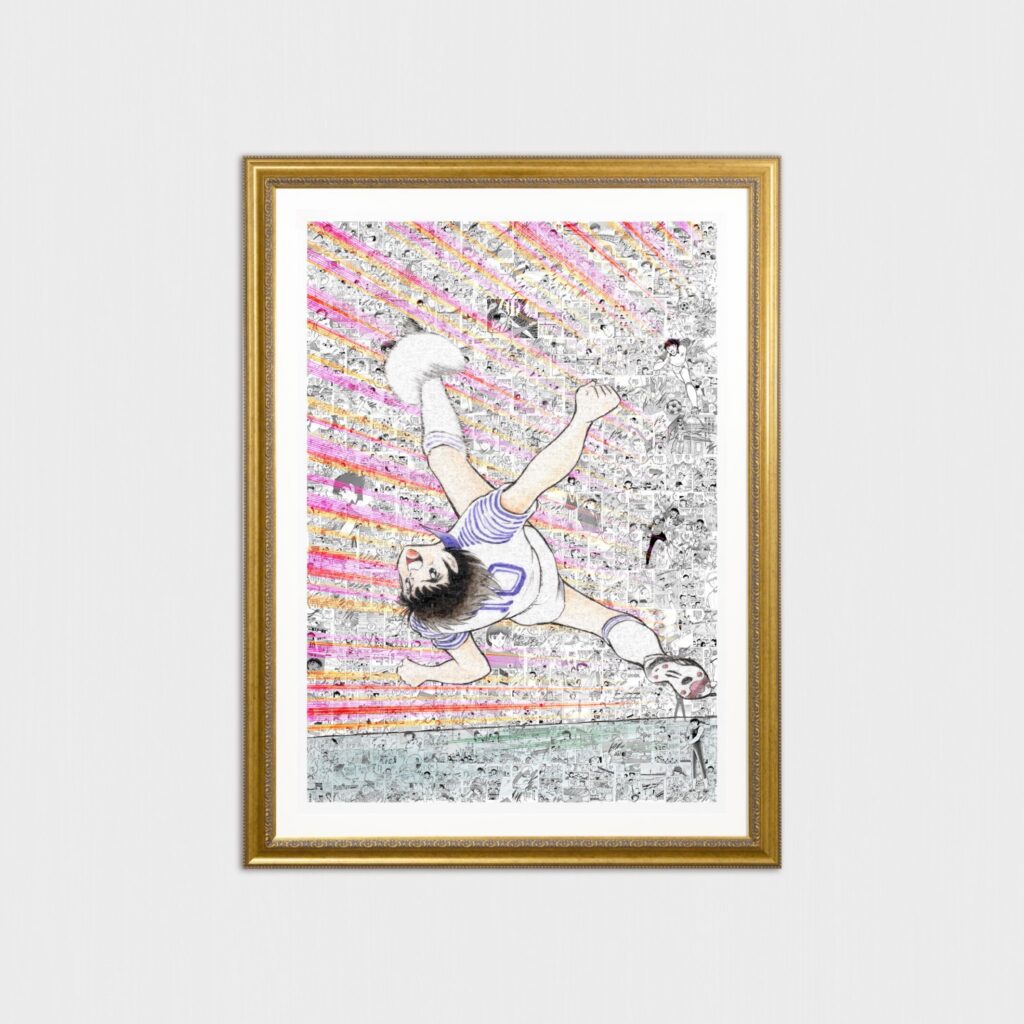
No.002 — Tsubasa Overhead Kick
Price: ¥990,000
Worldwide Limited Edition: 11
Size: 1,064 (H) × 763 (W) mm
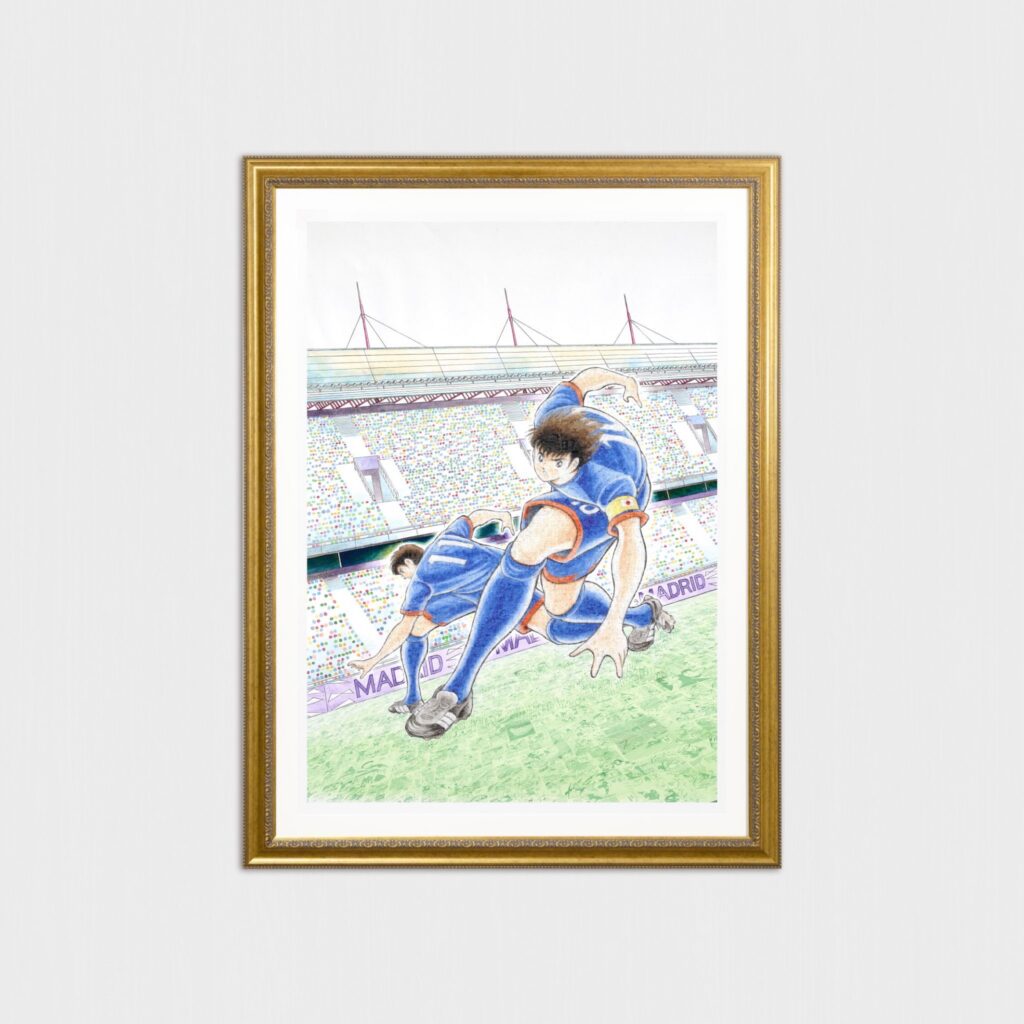
No.003 — Tsubasa & Misaki
Price: ¥990,000
Worldwide Limited Edition: 11
Size: 1,064 (H) × 763 (W) mm
No.005 — Exhibition-exclusive artwork
Price: ¥4,950,000
Worldwide Limited Edition: 11
Size: 763 (H) × 1,064 (W) mm
Prices, specifications, and sales formats are current as of this writing and may be subject to change depending on venue and availability.
What is GAAAT’s Original Art Technology, “Metal Canvas Art (MCA)”?
Metal Canvas Art (MCA) is a new art experience proposed by GAAAT. Each piece is carefully handcrafted by skilled artisans, combining the weight and beauty unique to metal with a striking sense of depth that creates an immersive viewing experience. The material is also highly durable, resistant to sunlight and humidity, so its beauty can be enjoyed for years to come. Using a specialized data-processing technique that divides digital artwork into 32 layers, MCA achieves remarkably fine detail in texture, depth, and color.
About GAAAT

GAAAT is an art brand that uses the power of art and technology to expand how IP content is expressed and experienced into a new dimension. Through original technology and creative vision, we expand the depth of worldbuilding and emotion into spatial, experiential form — redefining the power of IP as art.
Web: https://gaaat.com
GAAAT Gallery (EC): https://gallery.gaaat.com
Instagram: https://instagram.com/gaaat_art
X: https://x.com/gaaat_art