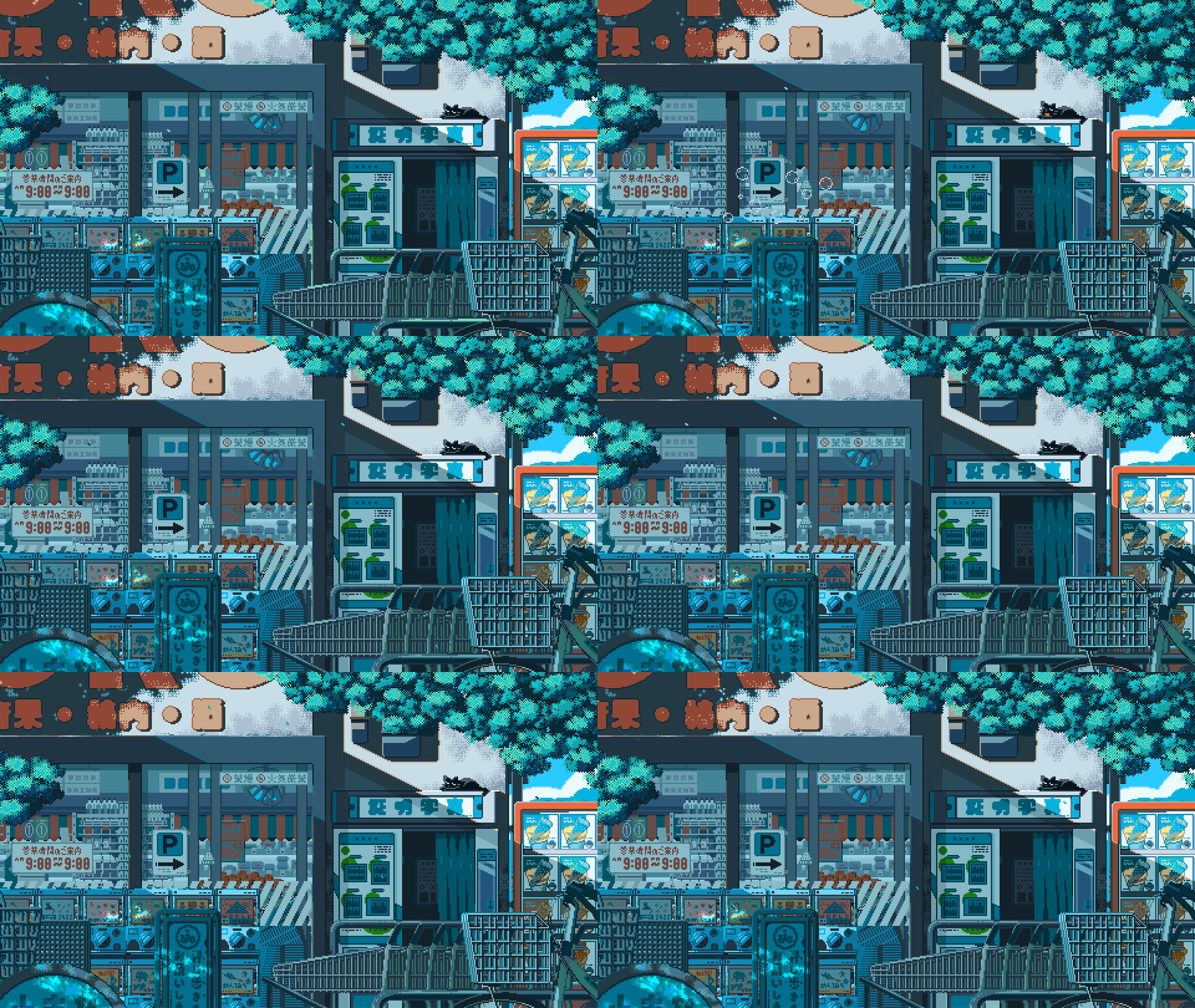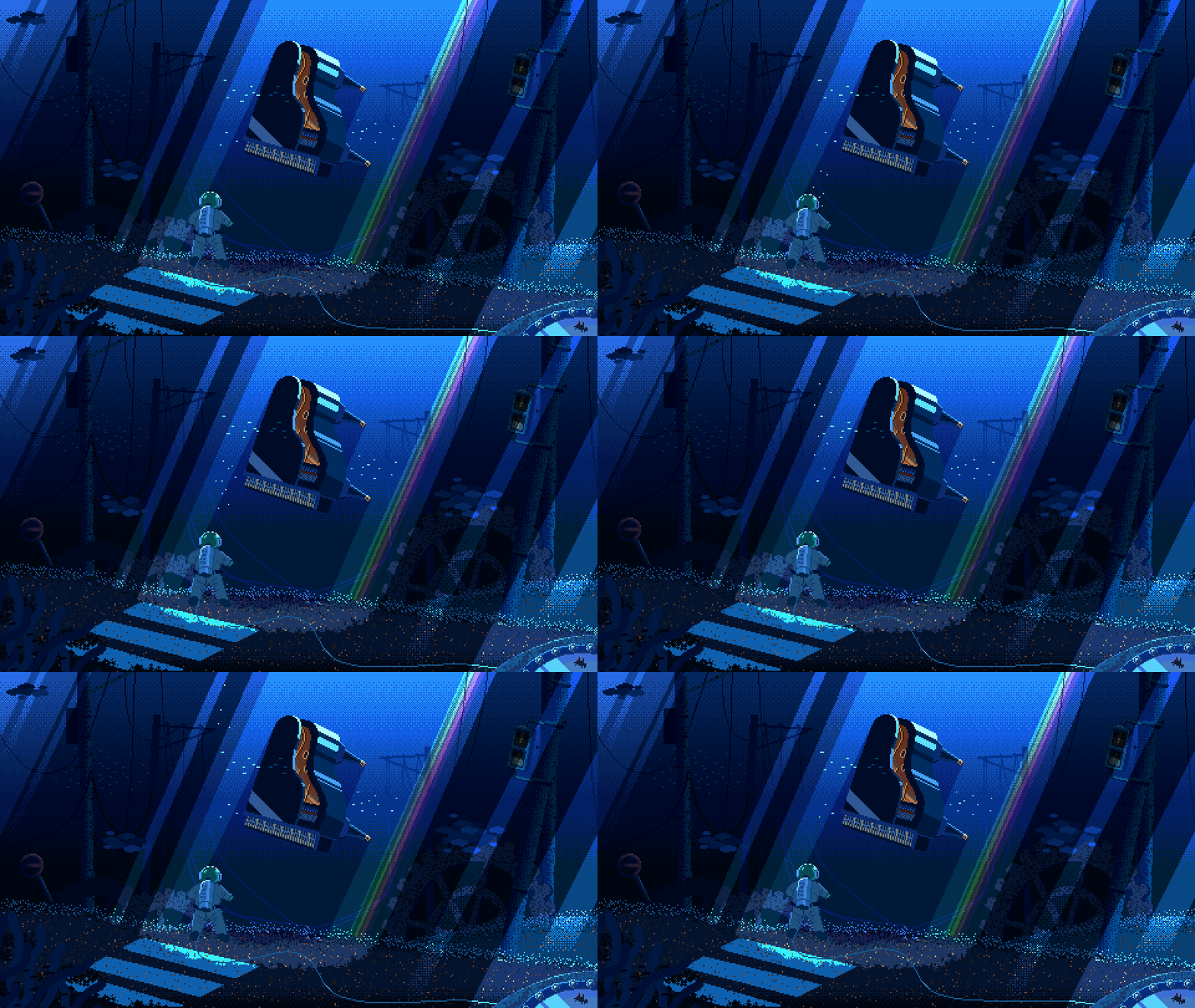
Even with landscapes you’ve never visited, you somehow feel nostalgic. This is the pixel art world of Yosca Maeda. In part one, we discussed his artistic processes and the meaning behind his name.
While Yosca Maeda’s work started as a digital work accessible anytime using digital screens, his annual solo exhibition since 2022 also has featured works designed to encourage more interactive engagement.
Expanding Possibilities Through Exploring Diverse Forms of Expression
At your solo exhibitions, you seem to experiment with the way you display your artworks.
Yosca Maeda:Yes. I’ve held three solo exhibitions so far, and each time I challenge myself with different forms of expression. I always try to question myself: “What can be possible when pixel art, a digital artwork, is experienced in a physical space?” I’m exploring the various ways people can engage with the pieces. I believe there is no correct answer to the way you display a digital work. Digital art could exist there through eyes, but can never be physically touched. And so, in my solo exhibitions, I want to experiment with systems that allow viewers to engage more actively with the works.
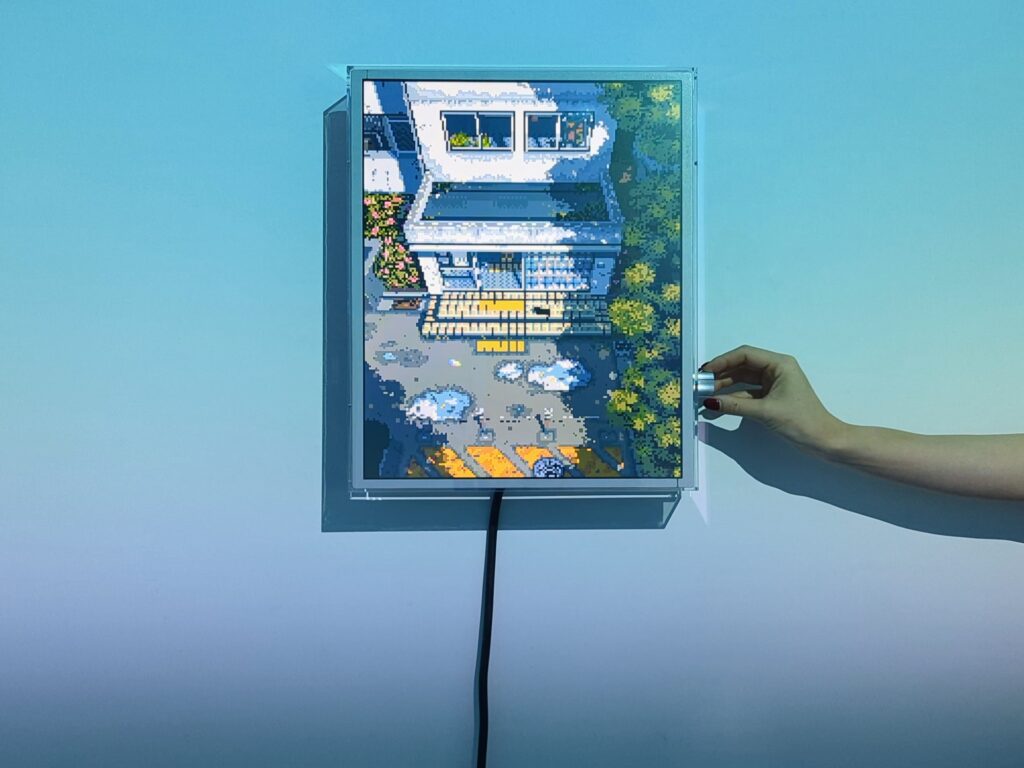
For instance, in my 2024 solo exhibition, I customized the monitors displaying my work by adding dials. When the viewers turn these dials, the pixels on the screen gradually change. What begins as an abstract form slowly becomes recognizable as a landscape. Through the changes in resolution, I tried to express the internal sensation of memories gradually gaining definition or returning its ambiguity. I also incorporated exhibitions of poetry fragments. Though I didn’t realize while drawing the piece, I find connections to lyrics I sang during my music career when looking back at them. The text changes over time, and I came to recognize the connection between certain words and images that I hadn’t thought were there.
Through this interview, I was particularly inspired by the way you choose your words. What has influenced you over the years?
Yosca Maeda: In terms of living philosophy, Taro Okamoto has long been a favorite artist of mine. My childhood home was close to the Taro Okamoto Museum of Art, and so I still buy an annual membership and make regular visits. I was able to start my career as a pixel artist without limiting myself to musical expression, perhaps influenced by Taro Okamoto’s aggressive pursuit of challenges across diverse fields.
What is The Future of Digital Art?
For creators in various fields, the advancement in AI and digital technology are significantly influential. How do you approach these technologies?
Yosca Maeda: As a creator working alongside digital technology, I’m interested in various emerging technologies. But what I value the most in my artistic work is the process itself. While AI-generated art has the strength of completing in a short time, it gives an impression of lacking creative motivation and process. I believe the process is where the reason for an artist’s and artwork’s existence lies. No matter how much technology advances, elements like why that piece was created and how much time was invested to complete it is where the depth is created, and artworks should exist to enable human connection.
I undoubtedly think that the digital quality will continue to improve, and many things will become increasingly convenient. Still, I hope each piece will embody its own journey of growth, outcomes, and stories within them.
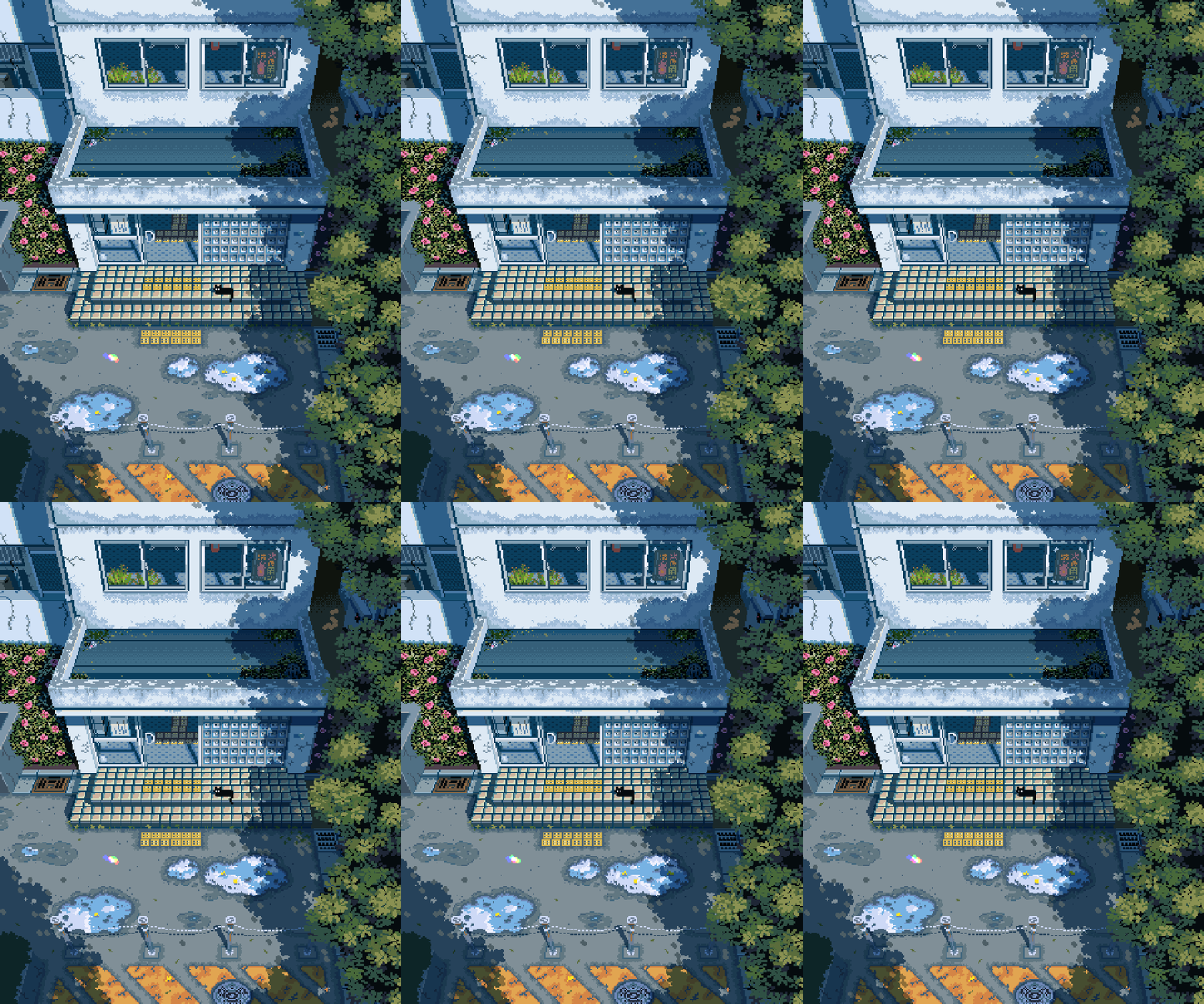
How do you see the future of digital art unfolding, Mr. Yosca Maeda?
Yosca Maeda:It may become a chaotic world. This has already become an issue but distinguishing between human-made and AI-generated work is just one example. As more variations emerge, I feel like we’ll reach a point where we are questioning what actually is something that is truly good. Just as some people find handmade items appealing in an era of mass production, I think the crucial aspect is understanding the maker, their purpose, their approach, and the work’s significance. As long as both the creator and receiver is a human being, I don’t think this stance will change. I also feel we are entering a positive era where we can deeply dive into our true passions.
Thanks to the connections from when I was a teacher, I’ve had opportunities to lead workshops for elementary school students. The children created pixel art animations using manageable canvas sizes, and watching them focus on the work reminded me of the importance of that pure yet engaging emotion of simply enjoying the act of creating something yourself.
ーーー Yosca Maeda’s words not being swayed by immediate results amid technological advancement was particularly memorable. With his vision both adaptive and strong, he looks forward to navigating the future with joy.