Digital and real. Subculture and high art. A project that bridges these seemingly opposing worlds is now in the spotlight. Under the title “ART OF MIKU”, the project reimagines Hatsune Miku – a beloved Japanese IP (Interactual Property) owned by Crypton Future Media, Inc. – through the lens of contemporary art, curated and produced by W.creation Inc. Known for redefining the value of characters and creative content, W.creation delivers fresh cultural experiences to audiences in Japan and beyond, bridging artists’ passion with the enthusiasm of countless fans. As cultures intersect and energy surges across creative boundaries, one can’t help but wonder – what kind of stories unfold behind the scenes of this vibrant, ever-evolving movement.
One standout example is “ART OF MIKU,” a contemporary art exhibition themed around Hatsune Miku, first held in Sapporo and Shibuya in 2024. Drawing large crowds of fans, the event proved to be a resounding success. Since then, the exhibition has continued its remarkable trajectory – unveiling new works and hosting shows in Yokohama, Roppongi, Kobe, Fukuoka, and Osaka. With such unstoppable momentum, it’s become nearly impossible to look away from its evolution.
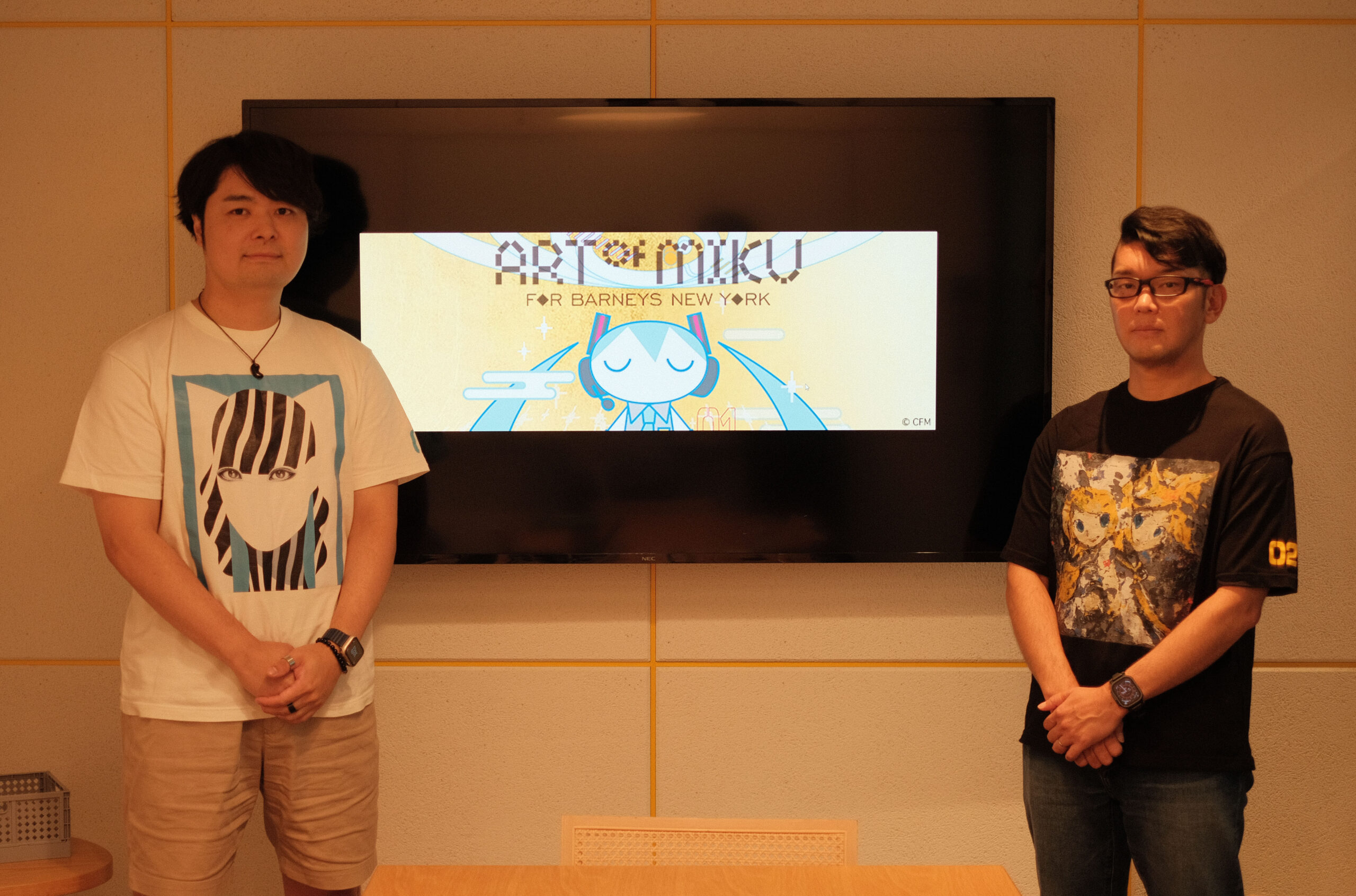
To explore the origins and creative journey of ART OF MIKU, we sat down with Genki Ikeda, Creative Director, and Masato Onishi, Art Director, for an in-depth interview. The story unfolds in two parts.

Behind the Passion That Powered “ART OF MIKU”
Nearly 400 meetings for one project sounds incredible. Why were so many meetings necessary?
Ikeda: Simply put, there were just so many people involved. From the co-organizing companies to the rights holders, collaboration partners, venue contractors, and even the subcontractors handling portions of the installation – each had their own progress that changed on a daily basis. We had to keep everyone updated in real time and provide quick feedback to avoid any backtracking.
Especially in the two to three months leading up to the launch, there were multiple deadlines and orders overlapping, so we were literally meeting every day. The sponsor companies were also running their own campaigns in parallel, so constant coordination had to be there.
I heard that all the members of “ART OF MIKU” also had their own full-time jobs. How did you manage to balance both?
Ikeda: Yes. This project started with a group of people who either had roots in art or a strong interest in it. On some days, we’d all work at our regular jobs during the day, then start project meetings in the evening. We were so absorbed that we sometimes even forgot to eat. It really felt like an after-school project.
Onishi: Most of our meetings were online, but some tasks required us to be on-site. Since I was in charge of directing the venue setup, I spent a lot of time at the actual venue. I had to check whether the artworks were placed as planned and whether the visitor flow worked smoothly. There were also unexpected issues that only became clear once we were actually at the site, so I had to deal with those on the spot. Honestly, there were times I felt that 24 hours a day wasn’t enough.

Were there any memorable episodes or moments at the exhibition site?
Onishi: During the Yokohama exhibition, we used a place called Hatsune-cho as the venue. The name was not only fitting because of “Hatsune Miku,” but the area itself is also known as a hub for contemporary artists and for its efforts to revive the local arts scene. Some visitors were even taking photos of the bus stop sign that said “Hatsune-cho,” not just the artworks.
It was fascinating to see that this led to offering fans a kind of “pilgrimage” experience – something rarely found in conventional art shows. It seemed that visitors truly appreciated that unique connection between place and art.

Art and “Hatsune Miku”: What Do They Mean to You?
As leaders of “ART OF MIKU,” a project that bridges the worlds of contemporary art and “Hatsune Miku,” what does art mean to you personally?
Ikeda: For me, art has been a part of my life since childhood—it is, in a way, synonymous with living itself. Through various forms of expression, art creates new worlds: the one an artist carries within, and the ones perceived by others. The meaning of a piece can change depending on each viewer’s interpretation, and often the artist finds that process fascinating as well. In society today, where so many rules and restrictions can feel stifling, art is one of the few things that can expand without denying the individual’s thoughts or perspective. For me, that makes it a true source of purpose. Art, in its essence, is life itself.
Onishi: I see art as a kind of “platform for dialogue.” It’s not just something you passively receive; the way an art viewer experiences or reacts to a piece is itself part of the expression. Through the artwork, a conversation unfolds between the audience and the artist – it becomes a kind of communication tool. When someone experiences a work and feels something new, that emotion is created through this interaction. In that sense, art functions as a platform for dialogue and co-creation.
Having shared both challenges and successes together, what kind of presence is “Hatsune Miku” for you?
Ikeda: For me, Hatsune Miku is a presence that transcends the boundary between the digital and the real. Contemporary art, in a similar way, dissolves the line between “pop culture” and “art culture,” blending the popular with the artistic. Hatsune Miku embodies that boundary-blurring quality – she is a platform that embraces diversity in all its forms.
Onishi: I see Hatsune Miku as a “receptacle for creativity.” She’s not just content to be enjoyed – she inspires people to create. Whether it’s composing music, drawing illustrations, or any other form of artistic expression, working with Hatsune Miku as a theme becomes a legitimate creative act. I think countless creators, as well as those aspiring to be creative, have benefited tremendously from her presence.
The Next Chapter of “ART OF MIKU”
How do you see “ART OF MIKU” evolving in the future?
Ikeda: From the very beginning, one of our goals for the project has been to share Japan’s captivating IPs not just domestically, but with the world. Through the character of Hatsune Miku, we hope to introduce the work of Japan’s talented artists to a global audience. Building on our success at home, we are actively exploring opportunities to expand internationally.
Onishi: We also plan to incorporate more participatory and immersive elements, not just exhibitions to look at. I want to create experiences that let people reminisce, thinking, “Oh, I made something like this at that workshop back then.” It’s about giving visitors a hands-on connection that they can remember and cherish.
To wrap up, do you have a message for the supporters of “ART OF MIKU”?
Onishi: With ART OF MIKU, we hope to continue welcoming new contemporary artists, offering fans more works and fresh expressions of Hatsune Miku. We will keep striving to meet everyone’s expectations and provide experiences that excite and inspire.
Ikeda: I am truly grateful that everyone has so warmly embraced the diverse expressions of contemporary art within this project. To meet those expectations, we will continue showcasing remarkable works through talented artists, and we plan to organize a variety of events to give back to those who have supported ART OF MIKU since the very beginning. Please look forward to what’s coming next.
To conclude this interview article, we are pleased to share a special comment from Kumiko Meguro, Manager of the License Business Team at Crypton Future Media, Inc., the rights holder of Hatsune Miku.
What do you hope to see from “ART OF MIKU” going forward?
Meguro: We often describe Hatsune Miku as a “hub” that connects different worlds, and I feel that ART OF MIKU perfectly embodies that idea. Through the project, we reach people who want to experience art, those who aren’t yet familiar with who Hatsune Miku is, and new expressions of Miku herself. Art transcends language, borders, and time.. it’s something that can be felt with the heart. In that sense, ART OF MIKU, with Hatsune Miku as the hub, connects a variety of worlds. Ideally, I hope that, through these artworks, the presence of Hatsune Miku will continue to be felt even 100 years from now.